
Copy.ai vs ChatGPT: Which Is Better for Your Business in 2026?
📅 Updated November 25, 2026
⏱️ 12 min read
Try Copy.ai →
Free plan available
You’re staring at a blank doc, a campaign deadline looming, and your team is split: half of them swear by Copy.ai’s ready-made marketing templates, and the other half won’t stop raving about ChatGPT’s raw versatility. It’s one of the most common debates we hear from marketers and business owners in 2026, and honestly, there’s no one-size-fits-all answer. We spent three weeks running both tools through the same real-world tasks — writing email sequences, generating ad variations, drafting blog posts, researching competitors, and building sales scripts — to give you a verdict grounded in actual use rather than spec sheets.
The honest truth? These two tools are increasingly playing in different lanes. Copy.ai has matured into a serious go-to-market (GTM) platform with workflow automation, CRM integrations, and a brand consistency engine. ChatGPT, now on GPT-5 architecture as of mid-2026, remains the Swiss Army knife of AI — brilliant at almost everything but deliberately un-opinionated about marketing workflows specifically. Choosing between them depends entirely on who you are and what you’re building.
In this review, we’ll break down features, pricing, real output quality, and the exact scenarios where each tool wins. We’ll also show you where the smart money is if you’re trying to decide which subscription to justify to your CFO this quarter.
What Are Copy.ai and ChatGPT?
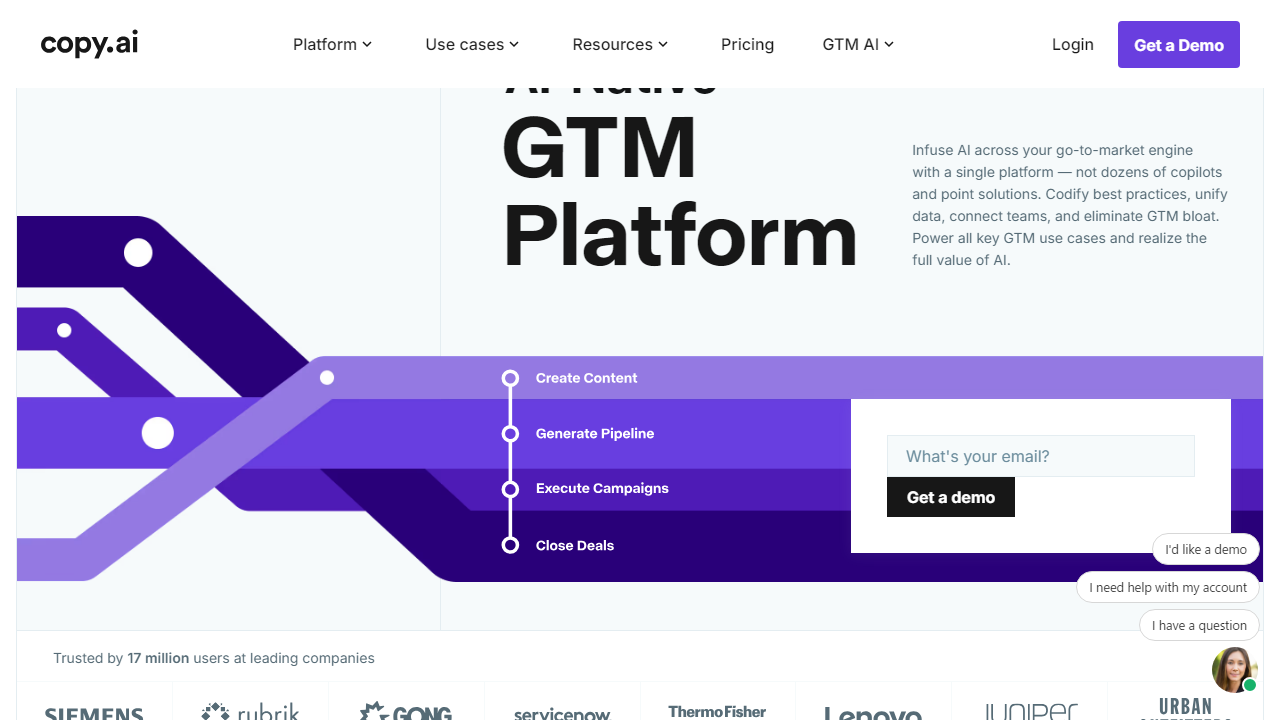
Copy.ai launched in 2020 as a simple AI copywriting tool and has since transformed into what the company now calls a “GTM AI Platform.” As of 2026, it claims over 10 million users globally and has raised more than $13.9 million in funding. The platform is built on top of large language models (including OpenAI’s API in earlier versions) but layers on proprietary workflows, brand training, and team collaboration tools specifically designed for marketing and sales teams. It’s headquartered in San Francisco and has become a go-to for revenue teams at companies like Salesforce, Zoom, and HubSpot.
ChatGPT, developed by OpenAI and launched publicly in late 2022, needs little introduction at this point. With over 200 million weekly active users as of 2026 and a product line that includes GPT-5, custom GPTs, a code interpreter, real-time web browsing, image generation, and an API ecosystem, it is the dominant general-purpose AI assistant on the market. ChatGPT Plus runs on GPT-5 and is OpenAI’s flagship consumer product, while ChatGPT Team and Enterprise serve business users with additional security and collaboration features.
The fundamental difference: Copy.ai is a vertical tool purpose-engineered for content and GTM use cases. ChatGPT is a horizontal platform that can do content work extremely well, but requires you to bring your own structure, templates, and workflows. Neither is objectively superior — the right answer depends on how you work.
Key Features Compared
We tested both tools across the same eight task categories. Here’s what actually mattered in day-to-day use.
Content Templates and Workflows
Copy.ai’s biggest structural advantage is its library of 90+ pre-built templates covering everything from Facebook ad copy and cold email sequences to product descriptions and LinkedIn posts. More importantly, its “Workflows” feature lets you chain multiple AI steps together — for example, pulling a prospect’s LinkedIn URL, generating a personalized outreach email, and writing three subject line variants, all in one automated flow. ChatGPT has no native templates; you build your own prompts from scratch or use community-shared custom GPTs, which vary wildly in quality.
Brand Voice and Consistency
Copy.ai’s Brand Voice feature allows teams to train the tool on existing brand materials — your website copy, tone guidelines, past campaigns — and then all outputs automatically reflect that voice. In our testing, this produced noticeably more on-brand results without constant re-prompting. ChatGPT can mimic a tone if you describe it in your system prompt or use a custom GPT, but there’s no persistent brand memory baked into the base product without custom API work. For teams producing high volumes of content across multiple writers, Copy.ai’s brand consistency is a genuine differentiator.
Raw Writing Quality
When we stripped away templates and workflows and simply asked both tools to write a 1,000-word blog post on B2B SaaS pricing strategy, ChatGPT-5 produced sharper, more nuanced, and better-structured prose. Its arguments were more sophisticated, the transitions were cleaner, and it required fewer editing passes. Copy.ai’s output was competent and usable but felt slightly more formulaic — fine for high-volume marketing copy, less ideal for thought leadership or editorial content. For raw long-form writing quality, ChatGPT wins clearly.
Research and Real-Time Information
ChatGPT Plus includes real-time web browsing via Bing integration, which means it can pull current statistics, check competitor pricing, and reference news from this week. Copy.ai’s base plans do not include live web access; the knowledge cutoff applies unless you manually paste in source material. If your content work requires current data — think market reports, trend pieces, or competitive analysis — ChatGPT has a meaningful edge here.
Team Collaboration
Copy.ai was built with teams in mind. The Team plan includes multi-seat access, shared Brand Voice, shared workflow libraries, and an approval workflow that lets managers review content before it goes out. ChatGPT Team offers shared workspace and admin controls, but there’s no approval workflow or brand governance layer. For marketing managers overseeing a team of writers or SDRs, Copy.ai’s collaboration architecture is noticeably more mature.
Integrations
Copy.ai integrates natively with Salesforce, HubSpot, Zapier, Webflow, and Shopify, among others — particularly useful for automating content generation that feeds directly into your CRM or CMS. ChatGPT integrates broadly through its API and supports third-party plugins, but native out-of-the-box CRM connections require more setup. For no-code GTM automation, Copy.ai wins on ease.
Pricing Plans
Both tools offer free tiers, but the limits are quite different. Here’s a side-by-side breakdown of what you’re actually paying for in 2026. Note that Copy.ai pricing is per-seat for teams, while ChatGPT pricing is per individual user.
| Plan | Price/mo | Best For | Key Limit |
|---|---|---|---|
| Copy.ai Free | $0 | Casual tryout only | 2,000 words/month |
| Copy.ai Pro | $36/mo | Solo marketers & freelancers | Unlimited words, 1 user |
| Copy.ai Team | $49/seat/mo | Marketing & sales teams | 5-seat minimum ($245/mo) |
| ChatGPT Free | $0 | Light personal use | GPT-4o mini, rate-limited |
| ChatGPT Plus | $20/mo | Power users, professionals | GPT-5, browsing, DALL-E 3 |
| ChatGPT Team | $30/seat/mo | Business teams | 2-seat minimum, admin controls |
The value math is stark: ChatGPT Plus at $20/month is one of the best deals in software for a solo user. Copy.ai Pro at $36/month makes sense if you’re using it daily for marketing tasks and the templates genuinely save you time. Where Copy.ai gets expensive is at the team level — $49/seat with a 5-seat minimum means $245/month minimum, compared to ChatGPT Team at $60/month for two people. Unless Copy.ai’s GTM workflows are driving measurable pipeline, that price gap is hard to justify for small teams.
Who Should Use Each Tool?
Best Alternatives to Consider
If neither Copy.ai nor ChatGPT feels like the perfect fit, these four alternatives are worth serious consideration in 2026.
| Tool | Starting Price | Best For | Our Rating |
|---|---|---|---|
| Jasper AI | $49/mo | Enterprise marketing teams | ⭐ 4.4/5 |
| Claude (Anthropic) | $20/mo | Long-form writing & analysis | ⭐ 4.5/5 |
| Writesonic | $20/mo | SEO-focused content creators | ⭐ 4.1/5 |
| Notion AI | $10/mo add-on | Teams already using Notion | ⭐ 4.0/5 |