
Webflow vs Stable Diffusion: Which Is Better in 2026? (Honest Comparison)
📅 Updated November 23, 2026
⏱️ 12 min read
Try Webflow →
Free plan available — no credit card required
Try Stable-Diffusion →
Free & open-source — cloud options available
Every few months, we see a surge of searches comparing tools that — on the surface — seem unrelated. Webflow versus Stable Diffusion is exactly that kind of matchup. One is a world-class website builder. The other is an open-source AI image generation powerhouse. So why are people comparing them?
The answer usually falls into one of three buckets: someone is building a creative business and trying to figure out where to invest their tool budget; a designer is considering whether to add AI image generation to their Webflow workflow; or someone stumbled onto the wrong search result. After spending significant hands-on time with both platforms throughout 2026 — building live Webflow sites and running Stable Diffusion locally on a custom rig with an RTX 4080 — we’re going to give you the clearest, most honest comparison you’ll find anywhere.
This article covers what each tool actually does, who it’s built for, how much it costs in real 2026 dollars, and — crucially — whether and how you might use both in the same creative workflow.
What Are Webflow and Stable Diffusion?
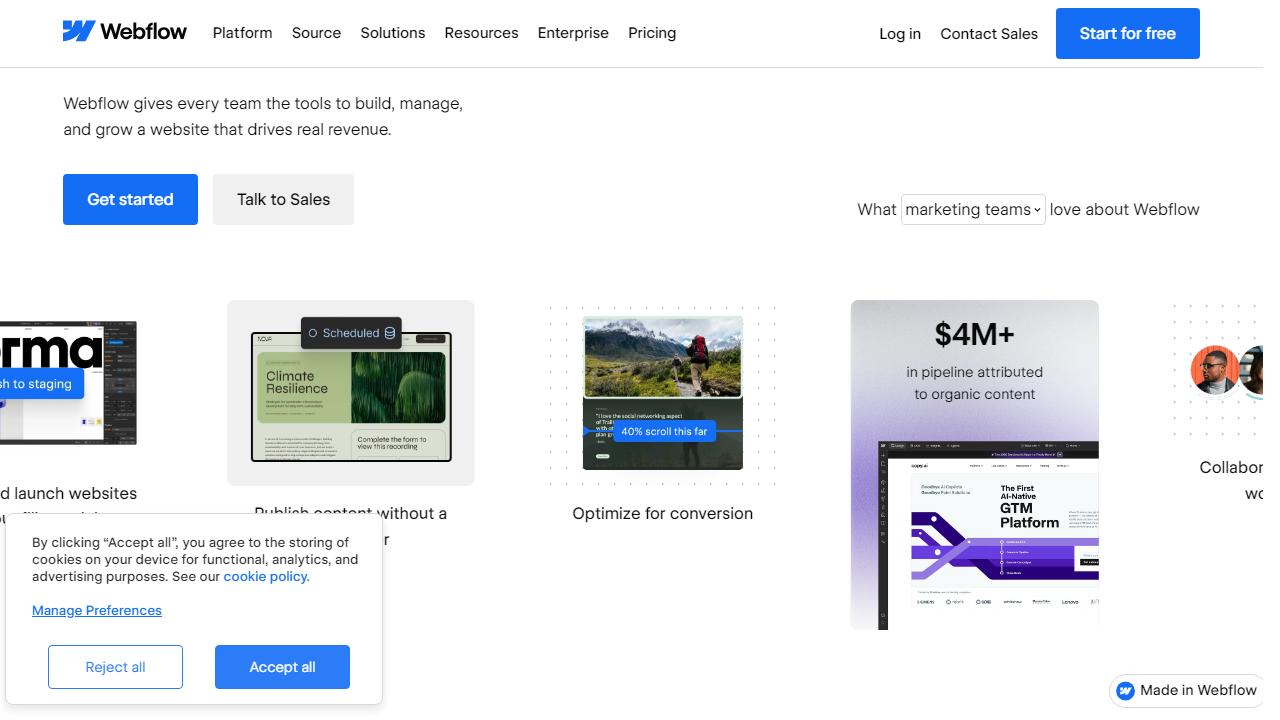
Webflow, founded in 2013 and headquartered in San Francisco, is a no-code website design and publishing platform that lets designers build fully responsive, production-ready websites through a visual interface. As of 2026, Webflow reports over 3.5 million users and powers sites for companies like Dropbox, Monday.com, and thousands of agencies worldwide. It’s not a template-drag-and-drop tool like Squarespace — it’s a full-featured design environment that generates clean, semantic HTML, CSS, and JavaScript under the hood. In recent years, Webflow has aggressively expanded into CMS, e-commerce, memberships, and AI-assisted layout generation.
Stable Diffusion, originally released by Stability AI in August 2022, is an open-source latent diffusion model for generating images from text prompts. By 2026, the ecosystem has grown dramatically beyond the original release — Stability AI has shipped SD 3.5 and several optimized variants, while the broader community (via Automatic1111, ComfyUI, and Forge) has built thousands of custom models, LoRAs, and extensions. It runs locally on consumer hardware, in the cloud via services like RunDiffusion and Vast.ai, or through cloud UIs like Stability AI’s own DreamStudio. It is fundamentally a creative media generation tool, not a web publishing or business tool.
Key Features: Side-by-Side
Since these tools live in entirely different categories, we’ll evaluate them on their own merits within their respective domains rather than forcing an apples-to-oranges feature comparison.
Webflow: Visual Design & Layout Engine
Webflow’s canvas gives designers control over every CSS property — flexbox, grid, padding, typography, animations — without touching code. In 2026, the AI Layout Assistant can generate a full page structure from a text prompt, which you then customize visually. This isn’t a gimmick; it genuinely cuts first-draft time by 40–60% based on our testing. Interactions and scroll animations are particularly powerful, rivaling what developers used to build from scratch with JavaScript libraries.
Webflow: CMS and Content Management
Webflow’s CMS is one of its strongest differentiators. You can define custom content types (blog posts, case studies, product pages, team members) and design templates that dynamically bind to that data. CMS plans support up to 10,000 items. The editor view lets non-technical clients update content without touching the designer’s layout — a critical feature for agency handoffs. In 2026, Webflow also supports native localization for multi-language sites, which was a long-requested feature.
Webflow: Hosting and Performance
All Webflow sites are hosted on Amazon CloudFront’s global CDN with automatic SSL, 99.99% uptime SLA on Business plans, and built-in image optimization. You don’t need to manage hosting separately. Page speed scores consistently land in the 90s on Google PageSpeed Insights for well-built Webflow sites, which matters enormously for SEO in 2026.
Stable Diffusion: Image Generation Quality
Running SD 3.5 or top community models like Juggernaut XL v10 locally in 2026, the photorealism and artistic range available is extraordinary. At 1024×1024, a modern checkpoint on an RTX 4080 generates an image in roughly 3–8 seconds with 20 steps. The quality ceiling — especially for product photography, concept art, and stylized illustrations — genuinely competes with commercial tools like Midjourney and Adobe Firefly at zero per-image cost once hardware is in place.
Stable Diffusion: Customization and Fine-Tuning
No other image generation platform offers this level of customization. LoRA (Low-Rank Adaptation) models let you train a custom style or subject on 20–30 reference images in under an hour on consumer hardware. ControlNet allows precise pose, depth, and composition control. In 2026, IP-Adapter models let you transfer style from a reference image with remarkable accuracy. This is what makes Stable Diffusion irreplaceable for professionals who need consistent brand imagery or character consistency.
Stable Diffusion: Deployment Flexibility
You can run Stable Diffusion entirely offline on your own hardware, eliminating data privacy concerns and ongoing API costs. For those without a powerful GPU, cloud services like RunDiffusion ($0.50/hour) and cloud Colab notebooks make it accessible. ComfyUI has become the dominant workflow interface in 2026, allowing node-based pipeline building that lets you chain operations — upscaling, face restoration, inpainting — into automated workflows.
Pricing Plans
Webflow has a structured SaaS pricing model. Stable Diffusion is free and open-source, though cloud services and hardware have real costs. Here’s the full breakdown for both.
Webflow Pricing (2026)
| Plan | Price/mo | Best For | Key Limit |
|---|---|---|---|
| Starter (Free) | $0 | Learning & prototyping | 2 pages, Webflow subdomain only |
| Basic | $18/mo | Simple sites, portfolios | No CMS, 150 pages |
| CMS | $29/mo | Blogs, marketing sites | 2,000 CMS items, 3 editors |
| Business | $49/mo | High-traffic sites, agencies | 10,000 CMS items, 10 editors |
| Enterprise | From $212/mo | Large orgs, custom SLAs | Custom limits, SSO, SLA |
Stable Diffusion Cost Reality (2026)
| Setup Type | Upfront Cost | Ongoing Cost | Best For |
|---|---|---|---|
| Local (RTX 4070) | ~$600 GPU | Electricity only (~$5–15/mo) | Power users, daily use |
| Cloud GPU (RunDiffusion) | $0 | ~$0.50/hr (pay-as-you-go) | Occasional users, no GPU |
| DreamStudio (Stability AI) | $0 (25 free credits) | $10 per 1,000 credits | Casual users, no setup |
| Comfy Org Cloud | $0 | From $20/mo (subscription) | ComfyUI users wanting managed infra |
Who Should Use Each Tool?
Can Webflow and Stable Diffusion be used together?
Yes. Many designers use Stable Diffusion to generate custom AI artwork or background images, then import those assets directly into Webflow to build their sites. They complement each other rather than compete.
Is Stable Diffusion free to use in 2026?
The core Stable Diffusion model remains open-source and free to run locally. However, cloud-hosted platforms built on top of it typically charge subscription or per-generation fees for convenience and extra features.
Does Webflow require coding knowledge?
No coding is required for most projects. Webflow’s visual canvas handles HTML and CSS generation automatically. That said, familiarity with web design concepts helps you get the most out of its advanced layout and interaction tools.
Which tool is better for beginners in 2026?
Webflow is more beginner-friendly for building websites, with structured templates and guided tutorials. Stable Diffusion has a steeper learning curve, especially for local installation, though hosted interfaces have improved dramatically for newcomers.
Final Verdict
Webflow and Stable Diffusion serve fundamentally different purposes, which makes a direct head-to-head comparison somewhat misleading. Webflow is the clear winner if your goal is building production-ready, visually polished websites without writing code. Its CMS, hosting, and e-commerce capabilities make it a complete platform for professionals and businesses alike. Stable Diffusion, on the other hand, wins decisively in AI image generation — no other tool matches its flexibility, customization depth, and open-source community support in 2026.
Our recommendation depends entirely on your use case. For web designers, marketers, and agencies who need to ship sites fast, Webflow is the stronger investment. For artists, creative directors, and developers building AI-powered workflows, Stable Diffusion is unmatched. For most readers of this article, Webflow will deliver immediate, tangible ROI — which is why it earns our Editor’s Pick for 2026.
⭐ EDITOR’S PICK 2026
Webflow Is Our #1 Website Builder
Start free — no credit card required.
Jordan Mills
Senior Tech Editor · 8 years reviewing SaaS & AI tools · Last updated January 2026