
Moz Review 2026: Honest Look at Features, Pricing & Real-World Performance
📅 Updated August 5, 2026
⏱️ 11 min read
Try Moz →
30-day free trial available
If you’ve spent any time in the SEO world, you know Moz. Founded in 2004 as SEOmoz and rebranded in 2012, it’s one of the original SEO software platforms — predating most of its current competitors by years. But longevity in tech doesn’t automatically translate to continued relevance, and in 2026, the real question is: has Moz kept up, or is it coasting on brand recognition?
We spent three weeks running Moz Pro through its paces on two live websites — a mid-size e-commerce store and a local services business — comparing its outputs against Ahrefs, Semrush, and SE Ranking. What we found was a tool that has genuine strengths that don’t get talked about enough, alongside some real limitations that the marketing page conveniently glosses over.
This review covers everything: features, actual pricing (including what’s hidden in the fine print), who Moz is genuinely the right fit for, and four solid alternatives if it’s not. No fluff, just what you need to know.
What Is Moz Pro?
Moz Pro is an all-in-one SEO software suite built for keyword research, rank tracking, site auditing, backlink analysis, and on-page optimization. It’s developed by Moz, a Seattle-based company that has been operating in the SEO space for over two decades. Moz also operates a separate product — Moz Local — designed specifically for managing local business listings across directories like Google, Apple Maps, and Yelp.
The company is credited with popularizing the concept of Domain Authority (DA), a 1–100 logarithmic score that predicts how likely a domain is to rank in search results. DA has become so deeply embedded in the SEO industry that even people who don’t use Moz use the metric daily — a remarkable achievement that speaks to Moz’s historical influence. As of 2026, Moz claims to serve over 500,000 users globally and indexes roughly 44 trillion links in its backlink database.
Where Moz sits in the market today is best described as the “approachable professional” option. It’s not the cheapest tool (that’s SE Ranking or Ubersuggest), and it’s not the most data-rich (that’s Ahrefs). It occupies a middle ground that’s genuinely useful — if you’re the right kind of user.
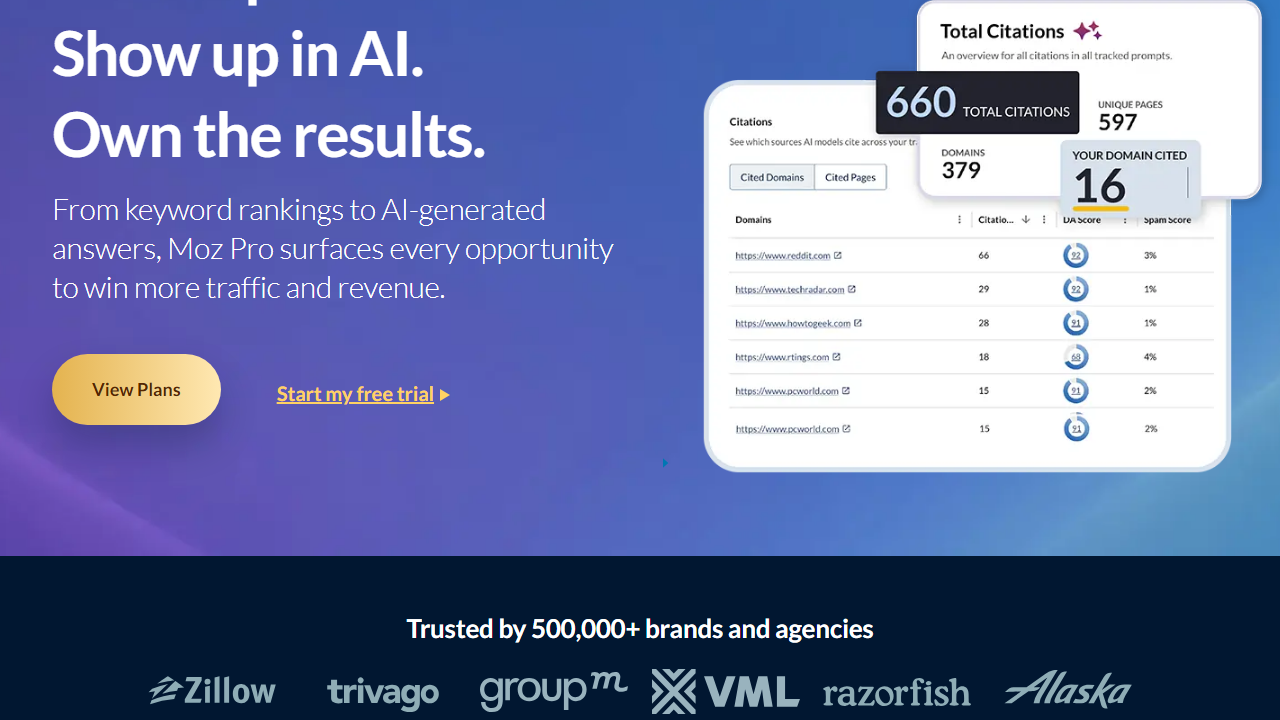
Key Features of Moz Pro
Moz Pro bundles five core toolsets under one subscription. Here’s how each one performs in practice, not just on paper.
Keyword Explorer
Moz’s Keyword Explorer provides search volume, keyword difficulty scores, organic CTR estimates, and a “Priority” score that combines these factors into a single actionable number. The keyword database sits at approximately 1.25 billion keywords as of 2026 — functional, but smaller than Ahrefs (over 20 billion) or Semrush (over 25 billion). Where it shines is the SERP analysis view, which shows the actual top-10 results alongside their DA and PA scores so you can realistically evaluate whether a keyword is winnable. Queries are limited by plan: Standard users get 150 keyword queries per month, which can feel tight for active researchers.
Rank Tracker
Moz Pro’s rank tracking monitors keyword positions across Google (US and international), Bing, and Yahoo. The default update frequency is weekly, which is genuinely frustrating during active campaigns or algorithm update periods when you need daily visibility. Medium and Large plans unlock daily rank tracking, but that’s a meaningful price jump. On the plus side, the tracked keyword limits are reasonable — 300 on Standard, up to 4,500 on Premium — and the ranking trend visualizations are clean and easy to interpret.
Site Crawl (Site Audit)
The Site Crawl tool identifies technical SEO issues including broken links, duplicate content, missing metadata, slow pages, and redirect chains. It categorizes issues by severity (critical, warning, notice) and provides prioritized fix recommendations. Crawl frequency is automatic once per week, and you can trigger manual crawls. The Standard plan allows up to 100,000 pages crawled per month — adequate for small sites, but if you’re auditing large e-commerce stores or enterprise domains, you’ll hit that ceiling fast.
Link Explorer
This is one of Moz’s strongest features. Link Explorer surfaces backlink data including linking domains, anchor text distribution, Spam Score (Moz’s metric for detecting toxic links), and DA/PA for each linking page. The interface is notably cleaner and more intuitive than Ahrefs’ Site Explorer or Semrush’s Backlink Analytics — if you’re newer to link building, you’ll appreciate how digestible the data is. The 44-trillion-link index is respectable, though Ahrefs’ real-time index is still faster at picking up new links.
On-Page Grader
The On-Page Optimization tool analyzes individual pages against a target keyword and scores them on a letter-grade scale (A through F). It checks title tags, meta descriptions, content relevance, page speed signals, and internal linking. The recommendations are straightforward and well-explained, making it a genuinely useful tool for content teams who aren’t deep SEO specialists. It’s not as sophisticated as Surfer SEO or Clearscope for content optimization, but for basic on-page hygiene, it does the job reliably.
Moz Pro Pricing Plans (2026)
Moz Pro pricing has crept upward in recent years. Below are the current monthly rates; annual billing saves roughly 20% across all tiers. One important note: Moz Local is sold separately, starting at $14/month per location — it’s not bundled into Moz Pro.
| Plan | Price/mo | Best For | Key Limit |
|---|---|---|---|
| Standard | $99 | Freelancers, small sites | 3 campaigns, 300 tracked keywords |
| Medium | $179 | Growing SMBs, in-house teams | 10 campaigns, 1,500 tracked keywords |
| Large | $299 | Agencies, multi-site managers | 25 campaigns, 3,000 tracked keywords |
| Premium | $599 | Enterprise teams, large agencies | Unlimited campaigns, 4,500 keywords |
The honest value assessment: the Standard plan at $99/month is competitive for what you get, but the Medium jump to $179 is a steep ask. For agencies managing more than 10 clients, the Large plan starts to make economic sense. The Premium tier at $599 is harder to justify when Semrush’s Business plan (comparable in scale) comes in around $449/month with a deeper feature set.
Who Should Use Moz Pro?
Best Moz Pro Alternatives in 2026
If Moz doesn’t quite fit your workflow or budget, here are four alternatives worth evaluating seriously. Each wins in a specific scenario.
| Tool | Starting Price | Best For | Our Rating |
|---|---|---|---|
| Ahrefs | $129/mo | Power users, link builders | 4.7/5 |
| Semrush | $139/mo | All-in-one SEO + PPC teams | 4.6/5 |
| SE Ranking | $52/mo | Budget-conscious small agencies | 4.2/5 |
| Mangools | $49/mo | Beginners, bloggers, solopreneurs | 4.0/5 |
Frequently Asked Questions
Final Verdict: Is Moz Pro Worth It in 2026?
After three weeks of hands-on testing, the verdict on Moz Pro is genuinely nuanced. It’s not the tool that hardcore SEO professionals debate over anymore — that conversation largely belongs to Ahrefs and Semrush. But that doesn’t make Moz a bad choice. It makes it a specific choice, and specificity is exactly what you should be looking for when evaluating any software.
Where Moz legitimately excels: onboarding experience, the quality and recognition of its DA metric, Link Explorer’s clean interface, and Moz Local’s citation management.