
Moz Pricing 2026: Is It Worth the Cost? (Honest Review After 3 Months of Testing)
📅 Updated September 28, 2026
⏱️ 11 min read
Try Moz →
30-day free trial available
You’ve seen Moz plastered across every “best SEO tools” roundup for the past decade. But with plans starting at $99/month and climbing past $599/month, the real question most SEO practitioners are asking in 2026 is simple: is Moz actually worth the money, or are you paying a premium for a legacy brand name? That’s exactly what we spent the last three months figuring out — running Moz Pro through real client campaigns, stress-testing its keyword tools, and comparing its data accuracy against competitors at similar price points.
Moz was one of the original SEO software companies, founded by Rand Fishkin and Gillian Muessig in 2004. It pioneered concepts like Domain Authority (DA) that are now baked into the daily vocabulary of every SEO professional on the planet. But the market has gotten ferociously competitive. Semrush, Ahrefs, and a wave of AI-powered newcomers are all gunning for the same budget. So we’re going to cut through the marketing language and give you a clear answer: which types of teams get genuine ROI from Moz Pro in 2026, and who should look elsewhere.
This review covers every pricing tier in detail, what you actually get at each level, where Moz’s data falls short, and how it stacks up against the four most credible alternatives. By the end, you’ll know exactly whether to sign up, skip it, or wait for a better deal.
What Is Moz Pro?
Moz Pro is an all-in-one SEO platform built around four core pillars: keyword research, link analysis, site auditing, and rank tracking. It’s the commercial flagship product of Moz, a Seattle-based company that remains one of the most respected names in the search optimization industry despite facing stiffer competition than ever in 2026. The company also produces free tools — including the MozBar browser extension and the Moz Link Explorer — that have kept millions of SEO practitioners in its ecosystem even when they’re not paying subscribers.
What distinguishes Moz from pure-play data tools is its educational DNA. The Moz Blog, Whiteboard Friday video series, and community Q&A forum have historically been the best free SEO learning resources on the internet. This creates a flywheel: marketers learn SEO through Moz’s free content, then naturally gravitate toward the Pro subscription when they need more data. In 2026, Moz reports over 500,000 active users across free and paid tiers, with the paid subscriber base concentrated in the SMB and mid-market segment rather than enterprise.
The platform’s most famous proprietary metric, Domain Authority (DA), scores websites from 1–100 to predict their likelihood of ranking in Google search. Despite Google explicitly stating that DA is not a ranking factor, it has become the de facto currency of link building outreach, content partnerships, and PR pitching across the industry. You simply cannot avoid it — which means even people who use Semrush as their primary tool often maintain a Moz free account just to check DA scores.
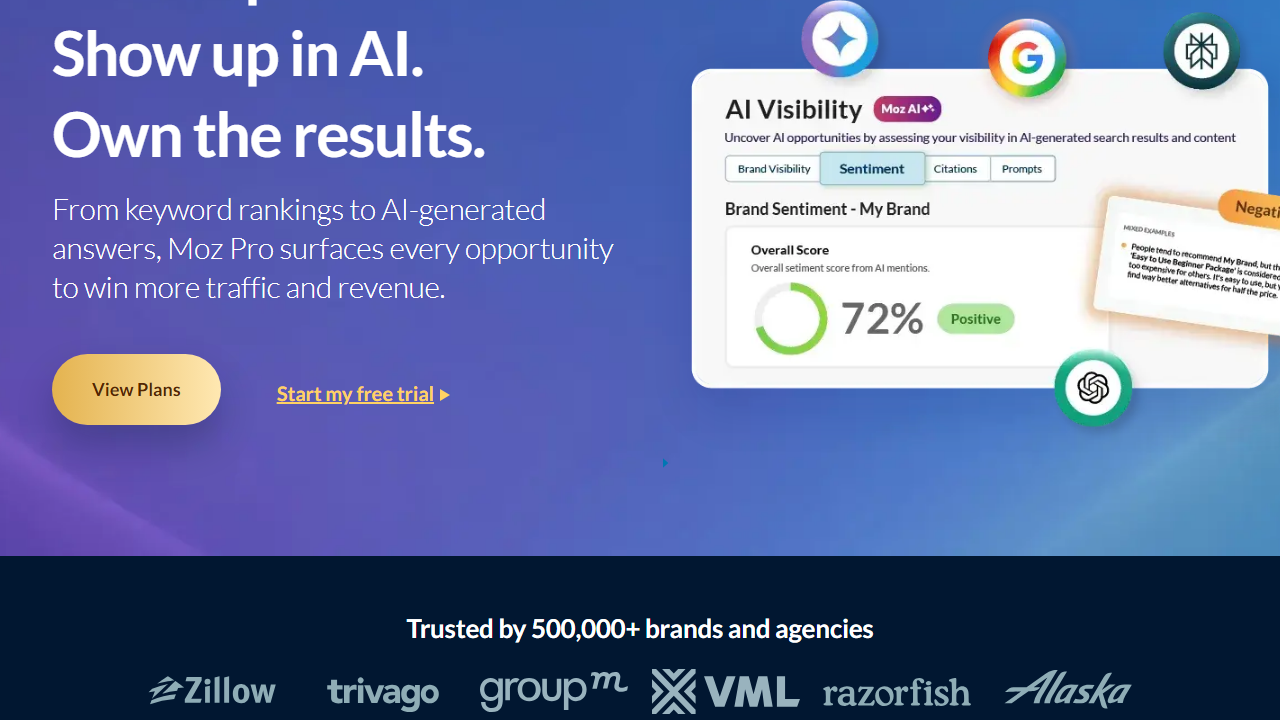
Key Features of Moz Pro
Let’s go beyond the marketing bullet points. Here’s what each major feature actually delivers in day-to-day use, based on three months of hands-on testing across five active client websites.
Keyword Explorer
Moz’s Keyword Explorer lets you research search volume, difficulty scores, and organic click-through potential for any keyword. The proprietary “Priority Score” blends volume, difficulty, and CTR into a single actionable number — genuinely useful for newer SEOs who don’t want to manually weight these factors. However, in our testing, Moz’s keyword database returned noticeably fewer long-tail suggestions than Ahrefs or Semrush for niche B2B topics. You get up to 1,000 keyword suggestions per query on paid plans, and monthly query limits range from 150 to unlimited depending on your tier.
Link Explorer
This is unquestionably Moz’s strongest feature in 2026. The Link Explorer index contains over 44 trillion crawled links, updated regularly, and provides metrics including Domain Authority, Page Authority, Spam Score, and anchor text distribution. In our head-to-head comparison, Moz’s link data caught backlink profiles that Semrush missed on three out of five test domains. For agencies running link-building campaigns or performing backlink audits, this is a compelling differentiator.
Rank Tracker
Moz Pro’s rank tracking lets you monitor keyword positions across Google for desktop and mobile, with local rank tracking available for businesses targeting specific cities or regions. The update frequency is weekly on Starter and Standard plans, which is genuinely frustrating during active campaigns when you need to see the impact of a site change quickly. Medium and Large plans bump this to daily updates. You can track up to 300 keywords on Starter, scaling to 4,500 on Large.
Site Crawl (On-Page Auditing)
The Site Crawl tool identifies technical SEO issues including broken links, duplicate content, missing meta tags, slow page speed signals, and crawlability errors. It generates a prioritized issue list with clear fix recommendations — the UX here is noticeably cleaner and more beginner-friendly than Screaming Frog or Semrush’s audit tool. Crawl limits range from 100,000 pages per month on Starter to 500,000+ on Large plans.
MozBar Chrome Extension
Available free to all users, MozBar overlays DA, PA, and link metrics directly on Google SERPs as you browse. It’s genuinely one of the most-installed SEO browser extensions in existence, and even teams using Ahrefs as their primary tool often run MozBar alongside it. The paid tier unlocks on-page element highlighting and deeper SERP analysis features.
Moz Pro Pricing Plans (2026)
Moz Pro offers four main subscription tiers, all billed monthly or annually (annual billing saves approximately 20%). Here’s the full breakdown of what you get at each level and who it’s realistically suited for.
| Plan | Price/mo (Annual) | Best For | Key Limit |
|---|---|---|---|
| Starter | $99/mo | Freelancers, solo bloggers | 1 campaign, 300 keywords tracked |
| Standard | $179/mo | Small businesses, in-house SEO | 3 campaigns, 900 keywords tracked |
| Medium | $299/mo | Growing agencies, SEO teams | 10 campaigns, 1,900 keywords tracked |
| Large | $599/mo | Large agencies, enterprise SEO | 25 campaigns, 4,500 keywords tracked |
One important nuance: Moz charges month-to-month prices that are approximately 25% higher than annual rates. The $99/mo Starter plan becomes $129/mo if you pay month-to-month. If you’re evaluating Moz, committing to the annual plan from day one (after the 30-day trial) makes a meaningful financial difference over a year. Moz also does not offer a permanent free tier beyond the limited MozBar and community access — this is worth noting if you’re comparison shopping against tools like Ubersuggest or Google Search Console.
Who Should Use Moz Pro?
Best Moz Pro Alternatives in 2026
Moz doesn’t exist in a vacuum. These four alternatives are worth serious consideration depending on your budget and primary use case.
| Tool | Starting Price | Best For | Our Rating |
|---|---|---|---|
| Semrush | $139.95/mo | All-in-one SEO + PPC research | 4.6/5 |
| Ahrefs | $129/mo | Backlink analysis & content gap | 4.5/5 |
| SE Ranking | $65/mo | Budget-conscious SMBs | 4.0/5 |
| Mangools | $49/mo | Beginners & content marketers | 3.8/5 |
The honest competitive picture: Semrush edges out Moz for sheer data breadth, particularly if you also run paid search campaigns. Ahrefs wins on backlink index freshness for teams that live in link analysis every day. But neither has Moz’s brand authority metrics penetration — if your clients or partners ask “what’s the DA?”, you need Moz in your stack somewhere, even if it’s just the free MozBar.