
ConvertKit Pricing Review 2026: How Much Does Kit Cost? (Every Plan Broken Down)
📅 Updated September 26, 2026
⏱️ 9 min read
Try ConvertKit →
Free plan available — no credit card required
You’re building an audience — a newsletter, a course, a podcast — and you need an email platform that won’t charge you like an enterprise on day one. ConvertKit has been the go-to name in creator email marketing since 2013, but with its 2024 rebrand to Kit and several pricing adjustments since then, plenty of people in 2026 are still asking: what does it actually cost? We tested every plan, dug through the pricing pages, and compared it against the top alternatives so you don’t have to.
The short answer is that ConvertKit’s pricing in 2026 ranges from $0/month to $65+/month depending on your subscriber count and the features you need. But the real answer is more nuanced — because the plan you’re on at 1,000 subscribers is a very different conversation than the one you’re having at 50,000. This article breaks down every tier, what you actually get, and whether it’s worth paying for over the competition.
We spent two weeks hands-on inside the Kit dashboard — building automations, testing the commerce tools, and stress-testing the deliverability — so every opinion here is grounded in real use, not a marketing page summary.
What Is ConvertKit (Kit)?
ConvertKit was founded in 2013 by Nathan Barry, a designer and blogger who was frustrated that existing email tools like Mailchimp were built for e-commerce businesses, not individual content creators. He built ConvertKit specifically for bloggers, authors, and course creators — and that DNA still runs through every feature decision the company makes today. In late 2024, the company officially rebranded to Kit, though most users still refer to it by its original name and both brand names are used interchangeably in 2026.
As of 2026, Kit serves over 600,000 creators globally and processes billions of emails per month. The platform has expanded well beyond basic email into a full creator ecosystem that includes landing pages, digital product sales, a subscriber referral network, and advanced automation. It’s bootstrapped and founder-led, which means pricing decisions tend to be more creator-friendly than those of VC-backed competitors chasing enterprise deals.
Kit’s market position sits squarely in the mid-market: more powerful than Mailchimp for automation, but simpler and more affordable than ActiveCampaign or HubSpot. If you’re a creator making money from your audience — or trying to — Kit is specifically designed to serve you.
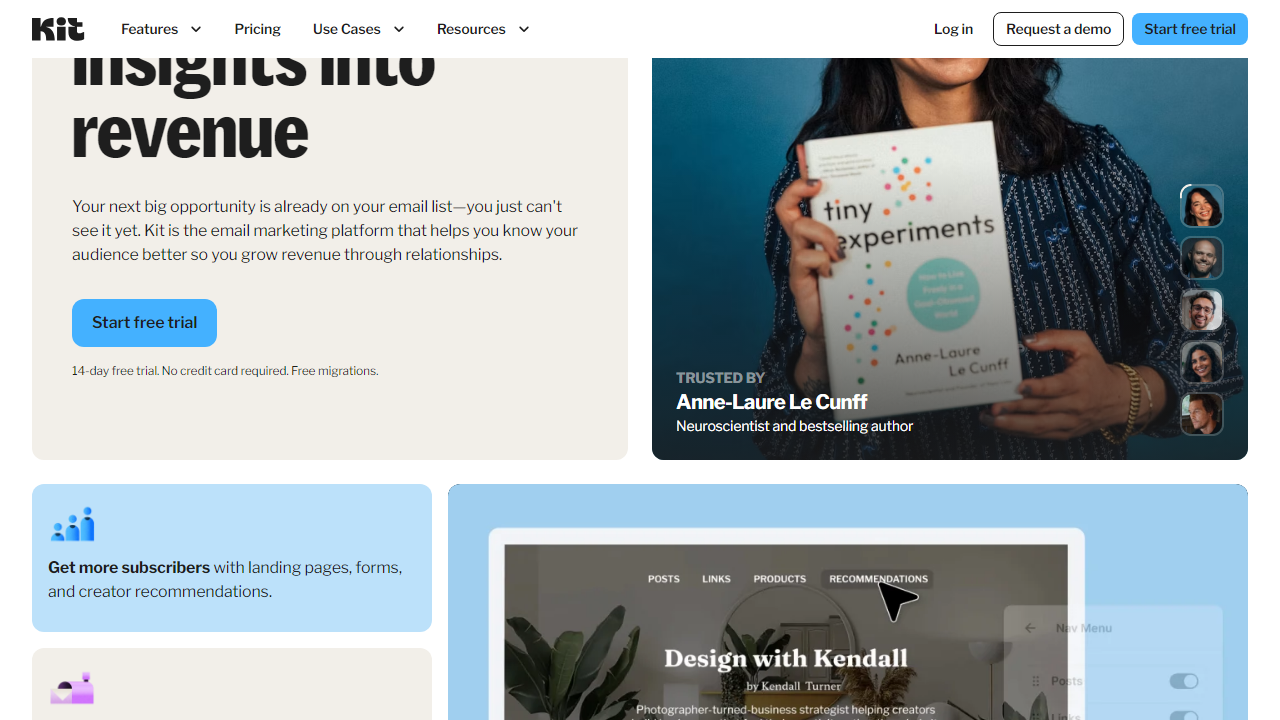
Key Features of ConvertKit (Kit)
Pricing only makes sense in context of what you’re actually getting. Here’s what Kit brings to the table across its plans in 2026.
Visual Automation Builder
Kit’s automation builder uses a drag-and-drop canvas that lets you map out subscriber journeys based on triggers like form signups, link clicks, purchases, and tags. Unlike Mailchimp’s more rigid sequence builder, Kit’s canvas approach makes complex multi-path automations readable at a glance. You can build sequences with unlimited steps on paid plans, while the free plan supports basic sequences only.
Creator Network
This is a feature competitors genuinely don’t have. Kit’s Creator Network lets you recommend other Kit creators to your new subscribers (and get recommended in return), driving organic list growth without paid ads. For active participants, creators report adding hundreds of subscribers per month purely through network cross-promotions. It’s available on all plans, including free.
Digital Commerce Tools
Kit includes a built-in digital product storefront where you can sell ebooks, courses, templates, and paid newsletters — with Kit taking a 3.5% transaction fee on the free plan and 0% on paid plans. This alone can make a paid plan pay for itself if you’re selling even modestly priced products. Stripe integration handles payouts, and there’s no additional monthly fee for the commerce functionality.
Landing Pages and Forms
Kit comes with a solid library of landing page and opt-in form templates — over 50 options as of 2026 — all of which are mobile-responsive and require zero code to customize. You can host them on a Kit subdomain for free or point a custom domain at them. For creators who don’t want to maintain a full website just to collect email signups, this is genuinely useful infrastructure.
Subscriber Tagging and Segmentation
Rather than the traditional list-based model used by Mailchimp, Kit uses a single-list architecture with tags and segments. This means a subscriber exists once in your account regardless of how many tags they have, which prevents the duplicate billing issue many Mailchimp users run into. Segmentation is available on all plans, making it accessible from day one.
Deliverability and Analytics
Kit consistently ranks among the top email platforms for inbox deliverability in third-party audits, typically posting deliverability rates above 99%. The analytics dashboard shows open rates, click rates, unsubscribes, and revenue attribution if you’re using the commerce tools. Creator Pro adds subscriber scoring and advanced reporting for power users who want deeper insights.
ConvertKit Pricing Plans in 2026
Kit’s pricing is subscriber-count-based, which means the prices below for the paid plans reflect the cost at up to 1,000 subscribers. Prices scale upward as your list grows — we’ve included the key breakpoints in the notes below the table. All prices shown are monthly billing; annual billing saves you approximately 17% across all paid tiers.
| Plan | Price/mo | Best For | Key Limit |
|---|---|---|---|
| Free | $0 | New creators starting out | Up to 10,000 subscribers; no automations; 3.5% commerce fee |
| Creator | $25/mo (up to 1K subs) | Growing creators needing automation | Unlimited sends; full automations; 0% commerce fee; scales to $65/mo at 10K subs |
| Creator Pro | $50/mo (up to 1K subs) | Established creators monetizing at scale | Everything in Creator + A/B testing, subscriber scoring, priority support; scales to $116/mo at 10K subs |
| Creator Pro (50K subs) | ~$379/mo | Large newsletter businesses | Full feature set; custom pricing available above 500K subscribers |
Important note on the Free plan expansion: In 2025, Kit significantly expanded the free plan from 1,000 to 10,000 subscribers — a massive shift that makes it one of the most generous free tiers in email marketing. However, the free plan does not include automation sequences, so you’re limited to one-off broadcast emails. For creators who just need to stay in touch with their audience without complex funnels, the free plan is legitimately powerful.
Annual billing discounts: At 1,000 subscribers, Creator drops to $290/year (≈$24.16/mo) and Creator Pro drops to $590/year (≈$49.17/mo) when billed annually. At higher subscriber counts, the annual savings become more meaningful — a 10,000-subscriber Creator Pro account saves over $240/year by going annual.
Who Should Use ConvertKit (Kit)?
Best ConvertKit (Kit) Alternatives in 2026
Kit is excellent for creators, but it’s not the right fit for everyone — especially as your list scales into the tens of thousands. Here’s how it stacks up against the leading alternatives.
| Tool | Starting Price | Best For | Our Rating |
|---|---|---|---|
| MailerLite | Free / $9/mo | Budget-conscious bloggers and small businesses | 4.4/5 |
| ActiveCampaign | $19/mo | Advanced marketers needing deep CRM + automation | 4.5/5 |
| Mailchimp | Free / $13/mo | E-commerce brands wanting visual email design | 3.8/5 |
| Beehiiv | Free / $39/mo | Newsletter-first creators focused on paid subscriptions | 4.3/5 |
MailerLite is the strongest value competitor — it offers automation on its free plan and is meaningfully cheaper at every subscriber tier above 10,000. If budget is your primary concern and you don’t need Kit’s Creator Network, MailerLite deserves serious consideration. Beehiiv is the closest spiritual competitor for newsletter creators, with better native paid newsletter infrastructure but fewer automation capabilities than Kit.