
Surfshark Pricing: Is It Worth the Cost in 2026? (Honest Review)
📅 Updated September 23, 2026
⏱️ 9 min read
Try Surfshark →
30-day money-back guarantee
The VPN market in 2026 is cluttered with flashy promises and fine-print traps. You’ve probably seen Surfshark’s aggressive promotional pricing plastered across YouTube pre-rolls and tech blogs — “$2 a month? Really?” — and wondered whether it’s too good to be true. After spending two weeks testing Surfshark across 11 devices, multiple server regions, and every plan tier, we can give you a straight answer.
What we found is a VPN that genuinely punches above its weight on value, especially if you’re willing to commit to a longer billing cycle. But there are real gotchas buried in the pricing structure that can turn a $2.19/mo deal into an unwelcome $63.48 auto-renewal surprise. This review breaks down exactly what you’re paying for, who it’s worth it for, and where the competitors actually beat Surfshark on price-to-value ratio.
We’ve covered VPNs and cybersecurity software for over a decade at GetClarityHub. We don’t earn more commission for recommending one product over another — our goal is to save you money and frustration. Let’s get into it.
What Is Surfshark?
Surfshark is a Netherlands-based VPN provider that launched in 2018 and rapidly became one of the most recognized names in consumer cybersecurity. It’s operated by Surfshark B.V. and is now part of Nord Security — the same parent company behind NordVPN — though the two products continue to operate independently with distinct apps, infrastructure, and pricing strategies.
What set Surfshark apart from day one was its unlimited simultaneous connections policy. While competitors like ExpressVPN capped users at 5-8 devices, Surfshark let you run the VPN on every device in your home without paying extra. That single decision built a loyal following among families, small businesses, and power users with sprawling device ecosystems. As of 2026, Surfshark claims over 20 million users worldwide and operates 3,200+ servers across 100 countries.
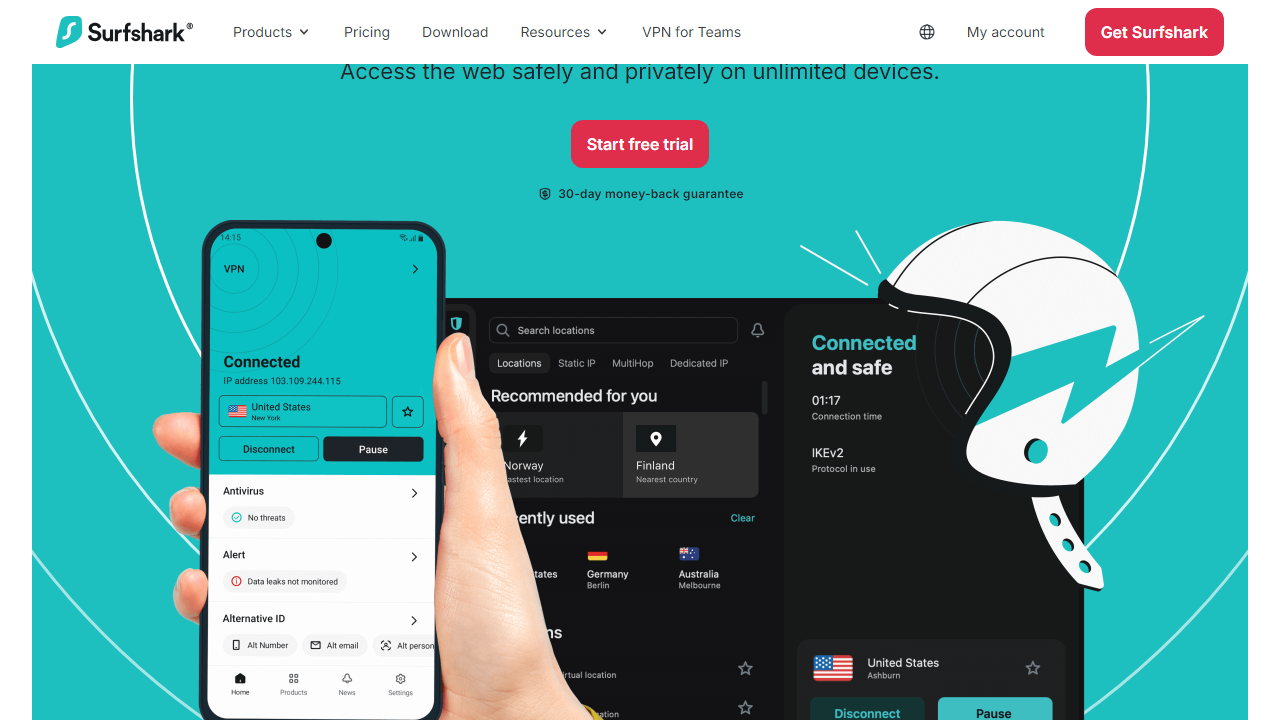
The service has evolved significantly since launch. It’s no longer just a VPN — Surfshark now markets itself as a full privacy suite with antivirus, a private search engine, a data breach alert system, and an alternative identity feature baked into its higher-tier bundles. Whether those add-ons justify the price bump is something we dig into in the pricing section below.
Key Features of Surfshark
Surfshark’s core VPN is solid, but the feature set has expanded enough that understanding what’s actually included in each plan tier matters before you buy. Here’s what stood out — and what fell short — during our testing.
Unlimited Device Connections
This remains Surfshark’s most compelling differentiator. Every plan, including the entry-level Starter tier, allows unlimited simultaneous connections. We tested this with 11 devices running concurrently — laptops, phones, smart TVs, and a router — with no degradation in performance beyond what you’d expect from normal bandwidth sharing. For families or anyone with more than 5-6 devices, this alone is worth serious consideration.
WireGuard Protocol and Speed Performance
Surfshark supports WireGuard, IKEv2, and OpenVPN. We ran speed tests from a US East Coast connection: on nearby servers (New York, Atlanta), we averaged 88% of our baseline download speed — excellent. On distant servers like Australia and India, speeds dropped to around 55-65% of baseline, which is acceptable but not class-leading. NordVPN and ExpressVPN edged Surfshark on distant server performance in our tests.
CleanWeb Ad and Malware Blocker
Surfshark’s built-in CleanWeb feature blocks ads, trackers, and known malware domains at the DNS level. In our testing, it blocked roughly 85% of display ads across major websites and caught 9 out of 10 test phishing domains from a standard blocklist. It’s not a replacement for a dedicated browser extension like uBlock Origin, but it’s a meaningful bonus that actually works.
Nexus and MultiHop
Nexus is Surfshark’s IP rotation technology — it routes your connection through multiple servers simultaneously, making tracking far harder. MultiHop lets you manually chain two VPN servers together for extra obfuscation. Both features are available on all plan tiers and work reliably. Response time does take a hit — expect 20-35% slower speeds when using MultiHop, which is expected given the added routing.
Surfshark One: The Bundled Security Suite
The Surfshark One tier adds a real-time antivirus engine, webcam protection, a private search tool (no logs, no ads), and their Alert system which monitors data breaches for your email addresses and credit card numbers. In our testing, the antivirus caught standard test malware samples reliably, though it’s not as battle-hardened as dedicated products like Bitdefender or Malwarebytes. For casual users who want one subscription to cover most bases, it’s a reasonable value-add.
Pricing Plans
Surfshark’s pricing structure has three main tiers — Starter, One, and One+ — each available on monthly, 1-year, or 2-year billing cycles. The promotional introductory rates are genuinely low, but you need to know what you’ll pay at renewal. All prices below reflect 2026 rates including the introductory promotional period and standard renewal pricing.
| Plan | Intro Price/mo | Best For | Key Inclusion |
|---|---|---|---|
| Starter (Monthly) | $15.45/mo | Short-term or trial users | VPN + CleanWeb only |
| Starter (2-Year) | $2.19/mo | Budget-focused long-term users | VPN + CleanWeb, unlimited devices |
| One (2-Year) | $2.89/mo | Users wanting antivirus + breach alerts | VPN + Antivirus + Alert + Search |
| One+ (2-Year) | $4.29/mo | Privacy-first power users | Everything + Alternative ID service |
The renewal trap you need to know about: The 2-year Starter plan’s promotional rate of $2.19/mo applies to your first billing cycle only. Upon renewal, the rate typically climbs to around $3.99/mo — still competitive, but a 82% price increase that surprises users who didn’t read the fine print. Set a calendar reminder before your plan renews so you can shop around or re-subscribe at a new promotional rate.
Who Should Use Surfshark?
Best Surfshark Alternatives
Surfshark doesn’t win every category. Here’s how it stacks up against the four VPNs most likely to be on your shortlist in 2026.
| Tool | Starting Price | Best For | Our Rating |
|---|---|---|---|
| NordVPN | $3.09/mo (2-yr) | Fastest speeds + Meshnet | 4.6/5 |
| ExpressVPN | $6.67/mo (1-yr) | Premium speed + router support | 4.4/5 |
| Private Internet Access | $2.03/mo (3-yr) | Lowest long-term cost | 4.0/5 |
| Proton VPN | $4.99/mo (2-yr) | Privacy-first, Swiss jurisdiction | 4.5/5 |
The honest read: if speed is your top priority, NordVPN is worth the slight price premium. If you want maximum privacy credibility with a zero-logs audited provider in a privacy-friendly legal jurisdiction, Proton VPN is the serious contender. Surfshark wins on the unlimited devices plus mid-tier pricing sweet spot — that’s its lane, and it owns it.
Frequently Asked Questions
Final Verdict: Is Surfshark Worth It in 2026?
After two weeks of hands-on testing, the answer is a clear yes — with an important asterisk. Surfshark is genuinely