
Make Pros and Cons: Full Breakdown — Is It the Best Automation Platform in 2026?
📅 Updated September 22, 2026
⏱️ 12 min read
Try Make →
Free plan available — no credit card required
If you’ve ever tried to automate your business workflows and hit a wall — either because a tool was too simple to handle your logic, or too expensive once you scaled — you already understand exactly why Make exists. The promise of no-code automation sounds great until you realize most platforms force you to choose between simplicity and power. Make refuses to make that trade-off.
We spent two weeks building real automation scenarios inside Make’s platform: syncing CRM data, routing support tickets, processing e-commerce orders, and connecting niche tools that Zapier’s library simply doesn’t cover. This review covers everything we found — the genuinely impressive capabilities, the real frustrations, and the honest answer to whether Make belongs in your workflow stack in 2026.
Make (rebranded from Integromat in 2022 and now fully under Celonis ownership after a 2024 acquisition) has grown into one of the most serious automation platforms on the market. With over 700,000 active organizations on the platform and more than 1,500 integrations, it’s no longer a scrappy European underdog — it’s a legitimate enterprise-grade option that still happens to be accessible to solo operators.
What Is Make?
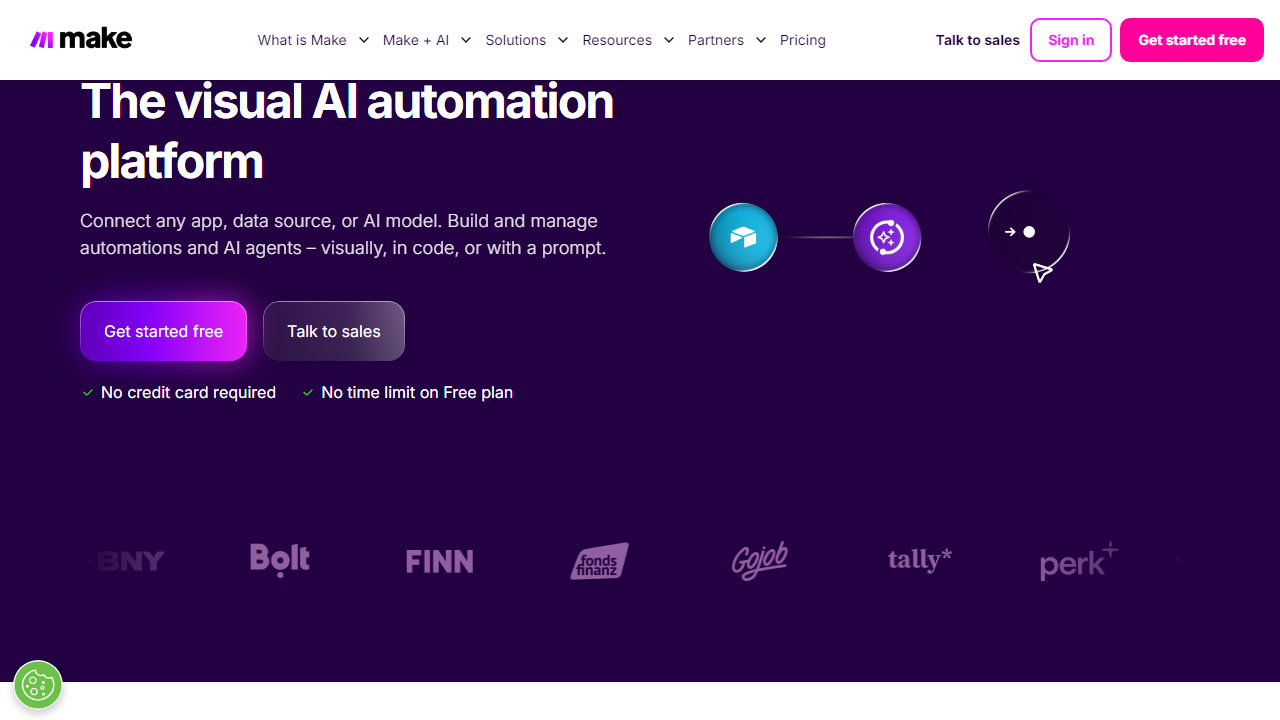
Make is a visual, no-code automation platform that lets you connect apps, move data, and build complex multi-step workflows — called “scenarios” — through a drag-and-drop canvas interface. Unlike linear automation tools that chain triggers and actions in a straight line, Make uses a node-based visual builder that lets you branch logic, loop through datasets, handle errors gracefully, and run parallel paths — all without touching a line of code.
The platform was originally built in Prague as Integromat in 2012 by Jaroslav Dolejš and Pavel Dolejš. It earned a devoted following among power users for its flexibility and pricing structure long before the rebrand. The Celonis acquisition brought deeper enterprise integrations and improved uptime SLAs, while the core product has remained focused on accessibility for teams of all sizes.
What sets Make apart from most competitors is its operations-based pricing model. Rather than charging per “task” or per “Zap” (like Zapier), Make charges per operation — each module execution within a scenario counts as one operation. This sounds minor until you realize it means a 10-step workflow costs 10 operations per run, not 10 separate task credits. For high-volume automations, this translates into real savings of hundreds of dollars per month.
Key Features of Make
Make is not a feature-light tool. Below are the capabilities that actually matter after two weeks of hands-on testing — and some honest caveats on each.
Visual Scenario Builder
Make’s canvas-based editor is genuinely one of the best in the automation space. You drag modules onto an infinite canvas, connect them with lines, and configure each step through a side panel. Branching paths (called “routers”) let you split workflow logic — for example, sending premium customers down one path and free users down another. After building about a dozen scenarios of varying complexity, the spatial layout actually helps you understand and debug your automations faster than a linear list ever could.
1,500+ App Integrations
Make’s integration library covers the obvious giants — Google Workspace, Slack, Salesforce, HubSpot, Shopify, Airtable — but also reaches into less common tools like Woodpecker, Clockify, Pipedrive, and dozens of niche SaaS products. There’s also an HTTP module that lets you connect to any REST API that isn’t in the native library, which effectively makes the integration count unlimited for technical users. Native webhook support is included on all plans.
Advanced Logic Tools
This is where Make genuinely outclasses simpler tools. Built-in iterators let you loop through arrays of data (say, every line item in an order). Aggregators collect and combine data across loops. Text parsers handle regex matching. The error-handling module lets you build retry logic and fallback paths so your automations don’t silently fail at 2 a.m. These aren’t add-ons — they’re first-class features available on every plan.
Scheduling and Real-Time Triggers
Scenarios can be triggered by webhooks (near-instant), on a schedule (down to every 1 minute on paid plans, 15-minute minimum on free), or manually. The scheduling flexibility is important: Zapier’s free plan restricts you to 15-minute polling intervals too, but Make’s paid plans unlock 1-minute intervals at a much lower price point than Zapier’s equivalent tier.
Data Store (Built-in Database)
Make includes a lightweight built-in database called Data Stores — essentially key-value tables you can read and write to within scenarios. This is enormously useful for deduplication, storing state between runs, or managing simple lookups without spinning up an external database. Each organization gets storage based on their plan tier, starting at 1 MB on the free plan up to 10 GB on Enterprise.
Pricing Plans
Make’s pricing is operations-based, which rewards efficient scenario design. All prices below reflect the monthly billing rate as of September 2026. Annual billing saves approximately 20% across all paid tiers.
| Plan | Price/mo | Best For | Key Limit |
|---|---|---|---|
| Free | $0 | Individuals testing the platform | 1,000 ops/mo, 15-min intervals |
| Core | $10.59 | Freelancers & small teams | 10,000 ops/mo, 1-min intervals |
| Pro | $18.82 | Growing businesses with complex flows | 10,000 ops/mo + priority support |
| Teams | $34.12 | Teams needing shared workspaces | 10,000 ops/mo, unlimited users |
A critical note: operations are purchased in bundles. The base plans above include 10,000 ops, but you can add additional operations in increments — roughly $9 per additional 10,000 ops on the Core plan. Compare this to Zapier, where 10,000 tasks per month runs $73.50/month (Starter tier). For power users, the cost difference is not subtle.
Who Should Use Make?
Best Make Alternatives
Make is excellent, but it’s not the only option. Here’s how it stacks up against the most credible competitors in 2026.
| Tool | Starting Price | Best For | Our Rating |
|---|---|---|---|
| Zapier | $19.99/mo | Beginners wanting simplicity | 4.1/5 |
| n8n | Free (self-hosted) / $24/mo cloud | Developers who want full control | 4.4/5 |
| Workato | ~$10,000/yr (enterprise) | Enterprise IT and compliance needs | 4.2/5 |
| Pabbly Connect | $19/mo (lifetime deals available) | Budget-conscious users, basic flows | 3.7/5 |
The clearest head-to-head is Make vs. Zapier. Zapier wins on simplicity and template library (with 6,000+ pre-built Zaps). Make wins on pricing, flexibility, and handling genuinely complex multi-path logic. For most users running more than 5,000 tasks per month, switching from Zapier to Make pays for itself within the first billing cycle.
Frequently Asked Questions
Final Verdict: Is Make Worth It in 2026?
After two weeks of hands-on testing — building real CRM sync workflows, e-commerce order routing scenarios, and AI-powered email processing automations — our conclusion is straightforward: Make is the best-value automation platform available to non-enterprise users in 2026, with one significant caveat. You have to be willing to learn it.
The operations-based pricing model is genuinely disruptive. Teams that have normalized paying $100–$300/month on Zapier can accomplish the same workflows on Make’s Core or Pro plan for under $30/month. The visual canvas, while intimidating at first, ultimately produces more maintainable and debuggable automations than a long list of linear Zap steps. And the advanced logic tools — routers, iterators,