
Semrush Pricing Review 2026: Is It Actually Worth the Cost?
📅 Updated July 10, 2026
⏱️ 11 min read
Try SEMrush →
14-day free trial available
Every SEO professional has had the same conversation: a client or boss asks why the monthly tool budget looks like a car payment. If Semrush is on that invoice, you know exactly why — and you also know how hard it is to justify $140, $250, or even $500 per month to someone who just wants to rank on Google. The price tag is real. So is the question: is Semrush actually worth it in 2026?
We spent several weeks running Semrush through its paces across three real websites — a local service business, a mid-size e-commerce store, and a content-heavy affiliate site — comparing its data against competitors and stress-testing its limits on every plan tier. This isn’t a surface-level overview. We’re going to break down exactly what you get at each price point, where Semrush genuinely earns its keep, and where it falls short. By the end, you’ll know whether to hit “subscribe” or keep shopping.
The short answer: for agencies, in-house marketing teams, and serious content operations, Semrush is likely the best single investment you can make in your SEO stack. For bloggers, freelancers, or bootstrapped startups watching every dollar, there are smarter entry points — and we’ll name them.
What Is Semrush?
Semrush is an all-in-one digital marketing platform headquartered in Boston, MA, founded in 2008 by Oleg Shchegolev and Dmitry Melnikov. What started as a competitive keyword research tool has evolved into a sprawling suite covering SEO, PPC advertising research, content marketing, social media management, local SEO, and competitive intelligence. As of 2026, Semrush reports over 10 million marketing professionals using the platform globally, with more than 1,000 employees across multiple offices.
The platform’s core value proposition is consolidation: instead of paying for Ahrefs (backlinks), BrightLocal (local SEO), SpyFu (competitor PPC), and a content optimization tool separately, Semrush bundles equivalent — and in many cases superior — functionality into one dashboard. That bundling is exactly why the price debate is so complicated. You’re not just buying an SEO tool; you’re buying a marketing intelligence command center.
Semrush went public on the NYSE in March 2021 (ticker: SEMR), which added a layer of financial transparency and accountability that private competitors lack. The company has continued investing heavily in AI-driven features throughout 2025 and 2026, including AI-powered content briefs, automated site audit fixes, and predictive keyword difficulty scoring.
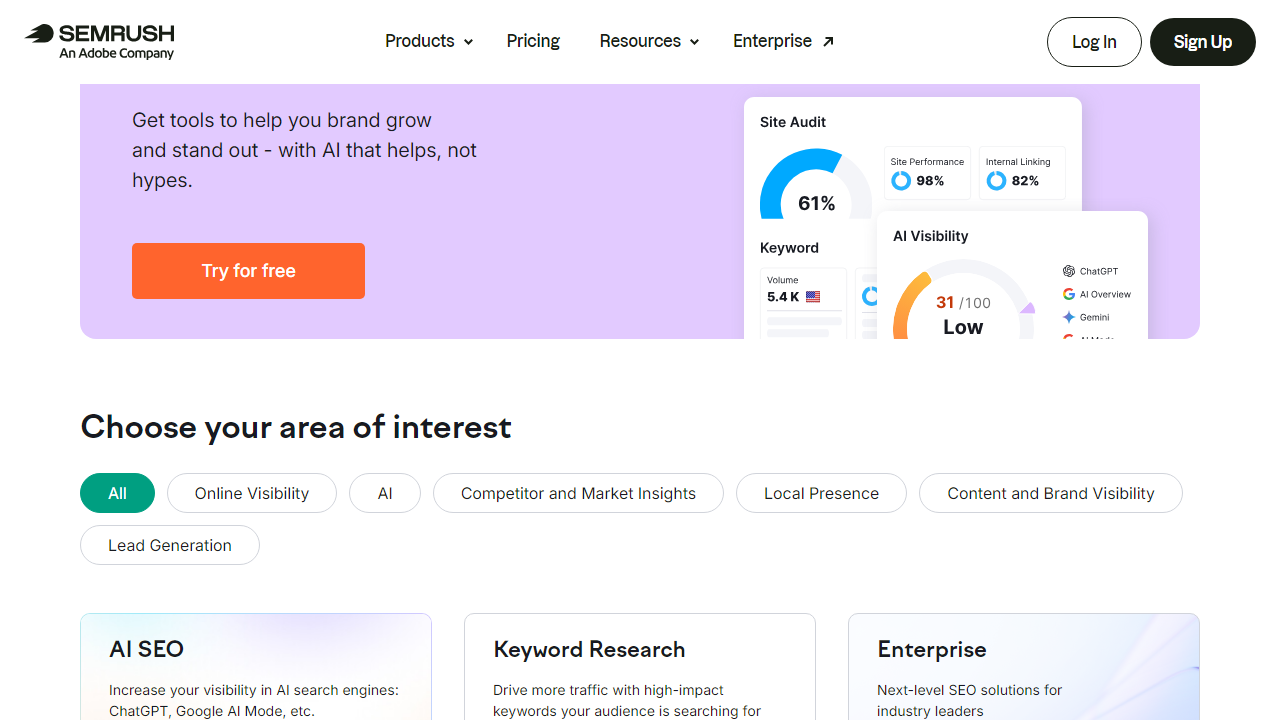
Key Features of Semrush
Semrush’s feature set is genuinely enormous — the platform lists over 55 individual tools. Here are the ones that actually matter and that we tested directly.
Keyword Research & Magic Tool
Semrush’s Keyword Magic Tool gives you access to over 25 billion keywords across 142 geographic databases — that’s not marketing fluff, it’s a genuinely staggering dataset that rivals anything else on the market. You can filter by intent (informational, navigational, transactional), SERP features, keyword difficulty, and CPC data. On the Pro plan, you get 10,000 results per report, which is sufficient for most campaigns; Guru and Business unlock 30,000 results per report.
Competitive Intelligence & Domain Analytics
This is where Semrush earns its reputation. Enter any competitor’s domain and you’ll get estimated organic traffic, their top-performing pages, the exact keywords driving that traffic, their backlink profile, and their paid ad copy — all in one view. The traffic estimates aren’t perfect (no tool’s are), but Semrush’s are consistently the most directionally accurate we’ve tested. For competitive strategy work, this feature alone can justify the subscription cost.
Backlink Analytics & Link Building
Semrush’s backlink database has grown substantially, now indexing over 43 trillion backlinks. The Backlink Audit tool connects directly to Google Search Console for more accurate toxic link identification, and the Link Building Tool automates prospecting and outreach management. Compared to Ahrefs, Semrush’s backlink data is slightly smaller in raw volume but the workflow tools are more polished and actionable.
Site Audit
Semrush’s Site Audit crawls up to 100,000 pages (on Pro), flagging over 140 technical SEO issues categorized by severity. What sets it apart from free tools like Screaming Frog is the prioritization engine — it ranks issues by estimated SEO impact, so you’re not wasting time on cosmetic problems. The 2026 update added AI-generated fix recommendations, which are genuinely useful for teams without a dedicated technical SEO specialist.
Position Tracking
Track daily keyword rankings across any location, device, and SERP feature. Pro plan users get 500 keywords tracked across 5 projects — this is the most commonly cited limitation by users, and it’s a legitimate complaint for agencies managing 10+ clients. Guru doubles it to 1,500 keywords; Business goes up to 5,000. Semrush’s local rank tracking (down to zip code level) is particularly strong for local SEO campaigns.
Content Marketing Toolkit
The Guru and Business plans unlock Semrush’s Content Marketing Platform, which includes the SEO Content Template, Content Audit, Topic Research, and the AI-powered SEO Writing Assistant (also available as a Google Docs and WordPress plugin). The Writing Assistant scores your content in real time against your top 10 competitors on tone, readability, originality, and keyword use. It’s not going to replace a skilled editor, but it’s a legitimate productivity multiplier for content teams.
Pricing Plans
Semrush pricing has increased modestly year-over-year. As of July 2026, here are the current monthly rates (annual billing saves approximately 17%). All plans include a single user seat; additional users cost $45/month each regardless of plan tier.
| Plan | Price/mo | Best For | Key Limit |
|---|---|---|---|
| Pro | $139.95 | Freelancers, small in-house teams | 500 tracked keywords, 5 projects |
| Guru | $249.95 | Growing agencies, content teams | 1,500 tracked keywords, 15 projects |
| Business | $499.95 | Large agencies, enterprise marketing | 5,000 tracked keywords, 40 projects |
| Enterprise | Custom (from ~$5,000/mo) | Large enterprises, data API access | Custom limits + API + dedicated support |
One pricing nuance worth knowing: several premium add-ons (Semrush Local, Agency Growth Kit, Trends) are sold separately and can significantly increase your total bill. Semrush Local, for example, runs $40–$80/month depending on tier, and the Trends competitive traffic analytics add-on is an additional $200/month. Factor these in if local SEO or deep competitive traffic data is central to your use case.
Who Should Use Semrush?
Best Semrush Alternatives
Semrush isn’t the only serious option in this space. Here’s how the top competitors stack up on price and specialization for 2026:
| Tool | Starting Price | Best For | Our Rating |
|---|---|---|---|
| Ahrefs | $129/mo | Backlink analysis, link building | ⭐ 4.5/5 |
| Moz Pro | $99/mo | Beginners, local SEO basics | ⭐ 3.8/5 |
| SpyFu | $39/mo | PPC competitor research on a budget | ⭐ 3.7/5 |
| Mangools | $29/mo | Keyword research, budget-conscious users | ⭐ 4.0/5 |
Our honest take: if backlinks and technical SEO are your primary focus, Ahrefs is a closer competitor to Semrush than the price gap suggests. If you just need solid keyword research without the full suite, Mangools at $29/month is legitimately excellent. For the full-stack marketing team that needs everything in one place, nothing beats Semrush.
Frequently Asked Questions
Yes, if SEO is a core growth channel. The Pro plan at $139.95/month delivers enough keyword, audit, and competitor tools to generate a positive ROI for most small businesses within the first few months of consistent use.
Semrush offers a limited free account with daily usage caps. Periodically they also offer 7-day or 14-day full-feature trials through promotional links, giving you unrestricted access before committing to a paid plan.
Yes. Semrush subscriptions are month-to-month and can be cancelled at any time from your account dashboard. Annual plans offer a discount but require an upfront commitment, so evaluate your needs before locking in.
Both tools are industry leaders. Semrush edges ahead for PPC research, content marketing, and local SEO features, while Ahrefs is often preferred for backlink depth and simplicity. Semrush’s all-in-one toolkit typically offers better value for agencies managing multiple channels.
Final Verdict
Semrush remains the most comprehensive SEO and digital marketing platform available in 2026. Its breadth of features — from technical site audits and keyword research to competitive intelligence and content optimization — makes it a genuine all-in-one solution rather than a collection of half-built tools. The pricing is not cheap, but for businesses that treat organic search as a serious revenue driver, the platform consistently pays for itself.
The Pro plan suits freelancers and growing businesses, while agencies will find the Guru or Business tiers justify their cost through white-label reporting and expanded project limits. If budget is a concern, start with a free trial to benchmark your current metrics, then measure tangible improvements over 90 days. Most users find the decision to upgrade straightforward once they see the data.
⭐ Editor’s Pick 2026
Semrush — Best All-In-One SEO Platform
Start with a free trial and explore 55+ tools risk-free.
Jordan Miles
Senior SEO Analyst · 9 years reviewing marketing software · Updated January 2026