Claude vs Midjourney: Full Comparison 2026 — Which AI Tool Is Actually Worth Your Money?
📅 Updated October 13, 2026
⏱️ 12 min read
Try Claude →
Free tier available for both tools
Here’s a question we get constantly at GetClarityHub: “Should I pay for Claude or Midjourney?” And every time, our honest answer is the same — it completely depends on what you’re trying to build. One is a text-based AI powerhouse; the other is the gold standard for AI image generation. They don’t overlap. But because both are premium AI subscriptions competing for the same $20–$30 in your monthly budget, the comparison is legitimate and worth having.
We spent three weeks running both tools through real professional workflows — drafting reports and debugging code with Claude, generating brand assets and concept art with Midjourney — testing the latest versions available in October 2026. This guide breaks down exactly what each tool does well, where they fall short, how their pricing stacks up, and most importantly, which one (or combination) belongs in your toolkit this year.
Fair warning: if you’re a designer or creative professional, this comparison might read differently than if you’re a writer or developer. That’s intentional. The right answer is never one-size-fits-all, and we’re not going to pretend otherwise.
What Are Claude and Midjourney?
Claude is Anthropic’s flagship large language model (LLM), positioned as one of the top-tier conversational AI assistants on the market alongside GPT-4o and Google Gemini Ultra. First launched in 2023, Claude has matured significantly — the Claude 3.7 Sonnet model powering the current Pro plan in 2026 handles complex reasoning tasks, 200,000-token context windows, advanced coding assistance, and nuanced long-form writing with a level of coherence that consistently impresses. Anthropic’s focus on “Constitutional AI” means the model is also notably safer and less prone to hallucinations than many competitors, which matters enormously in professional settings. The company reports over 30 million active monthly users as of mid-2026.
Midjourney, by contrast, is a visual AI tool — arguably the most influential image generation platform ever built. Founded in 2022 and bootstrapped to profitability without outside VC funding (a remarkable feat), Midjourney operates out of San Francisco with a small but intensely focused team. The platform’s v7 model, released in early 2026, pushed photorealistic rendering and artistic style control to new heights. Where competitors like DALL-E 3 and Stable Diffusion struggle with consistency and anatomical accuracy, Midjourney’s aesthetic quality remains a benchmark. It serves a reported 18 million registered users, with a significant portion being professional designers, marketers, and creative agencies.
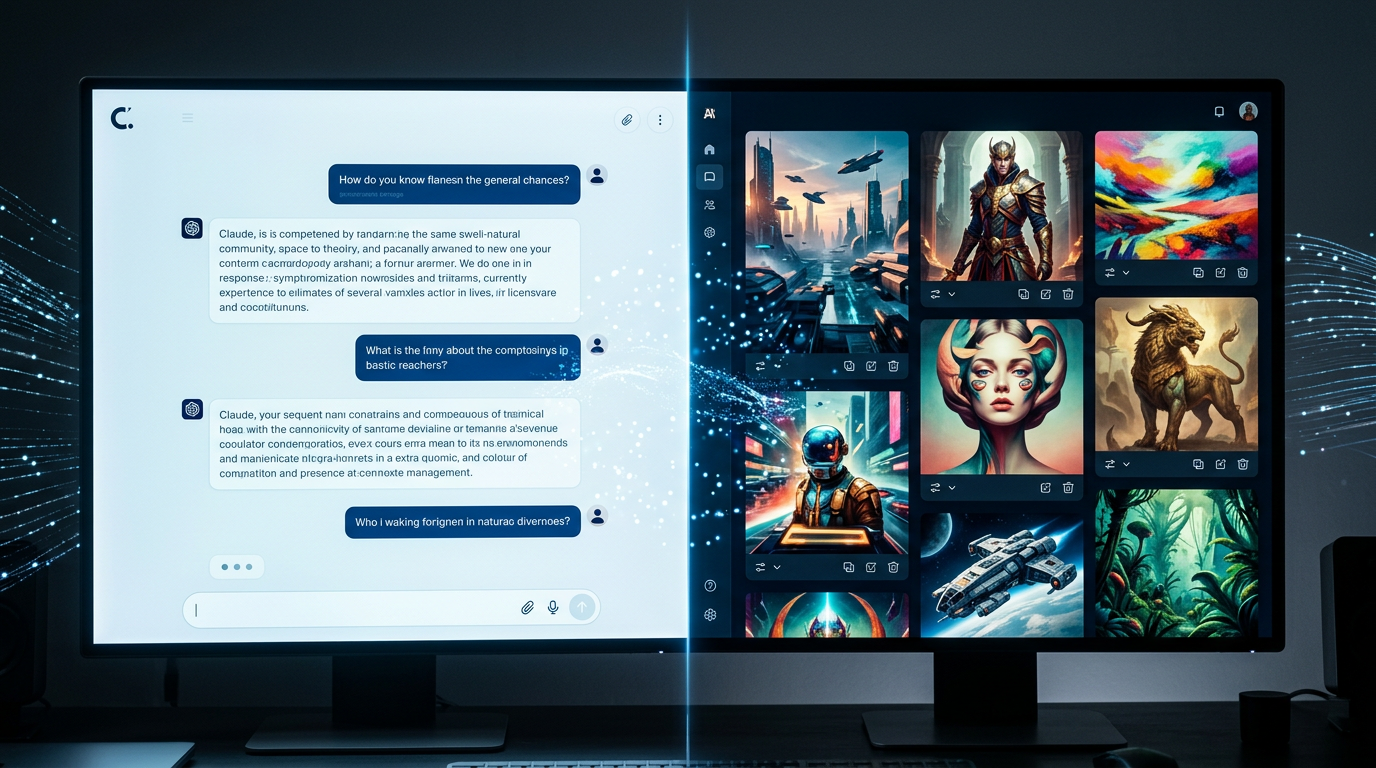
The critical point: these are not interchangeable tools. Claude can’t generate images (though it can write detailed image prompts). Midjourney can’t write your marketing copy or debug your Python script. The “vs” framing in this article is really about budget prioritization and understanding their distinct value propositions.
Key Features Head-to-Head
Let’s get granular. Rather than generic feature bullets, here’s how both tools performed across real tasks we ran during our three-week testing period.
Text Generation and Reasoning (Claude)
Claude’s 200K token context window is genuinely transformative for long-document work. We fed it a 90-page financial report and asked it to summarize, cross-reference, and identify inconsistencies — tasks it handled with impressive accuracy. For coding, Claude 3.7 Sonnet completed complex multi-file refactoring tasks that previous versions stumbled on. Creative writing quality is exceptional: the outputs feel less “AI-generic” than competitors, with tonal consistency that holds over thousands of words.
Image Generation (Midjourney)
Midjourney v7’s “consistent characters” feature — finally stable after a rocky v6 rollout — lets you lock a character’s appearance across multiple generations, which is a massive unlock for comic creators, brand designers, and game studios. Aspect ratio support now goes up to 21:9 natively, and generation speed on the standard plan averages 20–30 seconds per image. Style reference uploads work reliably, and the new “omni-reference” feature lets you blend multiple style sources in a single prompt.
Conversational Memory and Projects (Claude)
Claude’s Projects feature, available on Pro and Team plans, lets you maintain persistent context across sessions — essentially giving the AI a long-term memory of your work, documents, and preferences. For ongoing client work or research projects, this alone justifies the subscription. You can upload PDFs, spreadsheets, and code files directly into a project, and Claude references them intelligently throughout your conversation.
Prompt Flexibility and Control (Midjourney)
Midjourney’s parameter system is extensive: –stylize (0–1000), –chaos, –weird, –tile for seamless patterns, and –sref for style references give experienced users precise creative control. The web interface at midjourney.com has matured significantly — the editor tool now allows inpainting and outpainting directly in-browser, reducing dependency on third-party editing tools. Negative prompting with –no has also become more reliable in v7.
API and Developer Access
Both platforms offer API access, though the structures differ. Anthropic’s API is robust, well-documented, and widely integrated into third-party apps — it powers everything from legal tech startups to enterprise customer service tools. Midjourney’s API, still technically in limited beta for most developers as of October 2026, requires application approval and has usage restrictions that make it less accessible than competitors like Stability AI’s API.
Pricing Plans
Pricing across both platforms has remained relatively stable in 2026, though Midjourney introduced a new “Core” tier earlier this year to address gaps in their plan structure. Here’s a full breakdown of what you’ll actually pay.
Claude Pricing (Anthropic):
| Plan | Price/mo | Best For | Key Limit |
|---|---|---|---|
| Free | $0 | Casual users, testing | ~20 messages/day, no Projects |
| Pro | $20/mo | Freelancers, solopreneurs | 5x usage vs Free, Projects included |
| Team | $30/user/mo | Small to mid-size teams | Min. 5 seats, shared Projects |
| Enterprise | Custom | Large organizations | SSO, audit logs, custom data controls |
Midjourney Pricing:
| Plan | Price/mo | Best For | Key Limit |
|---|---|---|---|
| Basic | $10/mo | Hobbyists, casual exploration | ~200 image generations/mo |
| Standard | $30/mo | Freelancers, content creators | 15 hrs fast GPU + unlimited relaxed |
| Pro | $60/mo | Agencies, high-volume creators | 30 hrs fast GPU, stealth mode |
| Mega | $120/mo | Studios, enterprise creative teams | 60 hrs fast GPU, priority generation |
The value calculus is interesting here. Claude Pro at $20/month is a strong deal if text-based AI is central to your work — the 5x usage boost over the free tier and Projects feature make it feel like a different product entirely. Midjourney’s Standard plan at $30/month is the sweet spot for most creative professionals; unlimited relaxed mode images mean you’re effectively never blocked from generating, even if fast-mode hours run out.
Who Should Use Which Tool?
Best Alternatives to Consider
Neither Claude nor Midjourney is the only game in town. Depending on your specific needs, these alternatives might actually serve you better — or fill the gaps when used alongside your primary tool.
| Tool | Starting Price | Best For | Our Rating |
|---|---|---|---|
| ChatGPT Plus (OpenAI) | $20/mo | All-in-one text + image (DALL-E 3 included) | 4.5/5 |
| Adobe Firefly Pro | $9.99/mo | Designers needing commercially safe AI images | 4.1/5 |
| Google Gemini Advanced | $19.99/mo | Google Workspace users needing AI integration | 4.0/5 |
| Stable Diffusion (via DreamStudio) | ~$10/mo credits | Developers needing open-source image generation control |
Frequently Asked Questions
Can Claude generate images like Midjourney?
No. Claude is a text-based AI assistant — it writes, analyzes, and codes but does not generate images. Midjourney is exclusively an image-generation tool. They solve fundamentally different problems, so many creators use both together.
Which tool is cheaper in 2026?
Claude offers a generous free tier plus paid plans starting around $20/month. Midjourney requires a paid subscription from the start, beginning at approximately $10/month for basic image generation. For budget-conscious users, Claude provides more free utility day-to-day.
Is Claude better than ChatGPT for writing tasks?
Many professional writers and developers prefer Claude for long-form content, nuanced reasoning, and following complex instructions. Claude consistently handles longer context windows and produces more natural-sounding prose, though both tools have their strengths depending on the use case.
Do I need both Claude and Midjourney?
If your workflow involves content creation, many professionals use Claude to write prompts, scripts, and captions — then feed those outputs into Midjourney for visuals. Together they form a powerful creative pipeline that neither tool can replicate alone.
Final Verdict
Comparing Claude and Midjourney is genuinely an apples-to-oranges situation — but that doesn’t make the choice any easier when money is on the line. If your primary needs involve writing, research, coding, or complex reasoning, Claude is the clear winner and offers exceptional value even on its free plan. Midjourney wins decisively the moment visuals enter the equation, with image quality that still sets the industry benchmark heading into 2026.
For solo creators and small teams, we recommend starting with Claude as your daily AI workhorse and adding a Midjourney basic plan only when your projects demand original imagery. The combination is hard to beat, but if forced to choose just one general-purpose tool that delivers consistent ROI across the widest range of tasks, Claude earns our top recommendation this year.
⭐ Editor’s Pick 2026
Claude — Best All-Round AI Assistant
Unmatched for writing, analysis & coding. Start free today.
Jamie Mercer
Senior AI Tools Reviewer · 6 years testing productivity software · Updated January 2026