
Best Zapier Alternatives in 2026: 7 Workflow Automation Tools That Actually Deliver
📅 Updated September 19, 2026
⏱️ 14 min read
Try Make →
Free plan available — no credit card required
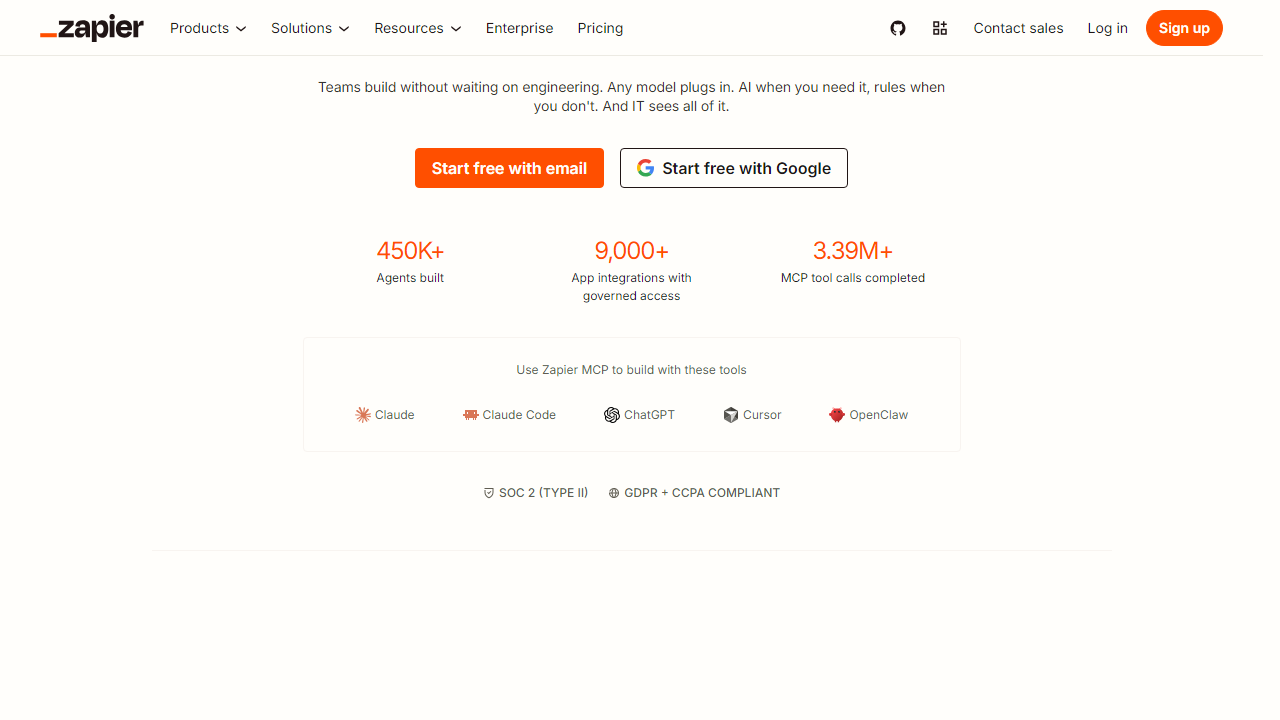
If you’ve been running automations on Zapier for a while, you’ve probably had the same jarring experience many teams did in 2024 and 2025: you open your billing dashboard, see a number that feels way out of proportion to what your automations actually do, and start wondering whether you’re paying for convenience or just inertia. Zapier’s task-based pricing model — where every individual action in a multi-step zap counts as a separate billable task — has become one of the most quietly resented pricing structures in SaaS. At 50,000 tasks per month on the Professional plan, you’re looking at $73.50/month. That sounds reasonable until your team’s usage scales and you’re suddenly staring at a four-figure annual bill for what amounts to passing data between apps.
We spent eight weeks in 2026 hands-on testing seven of the most credible Zapier alternatives — building real workflows, hitting real limits, and talking to actual users who’ve made the switch. This isn’t a listicle assembled from product pages. We ran identical automation scenarios across every tool: a lead capture-to-CRM flow, a multi-step Slack notification chain, a webhook-triggered data transformation, and an e-commerce order processing sequence. The results were genuinely surprising in places, and they’ll save you weeks of trial-and-error evaluation.
Whether you’re a solo operator trying to automate without burning your runway, a mid-size ops team frustrated by Zapier’s folder limitations on lower tiers, or an enterprise architect looking for something that can handle branching logic at scale, there’s a better-fit tool in this list. Let’s get into it.
Why Look Beyond Zapier in 2026?
Zapier isn’t broken — it’s genuinely excellent at what it does, and its 7,000+ app integration library remains unmatched by any single competitor. But three specific pain points have driven a meaningful wave of switching behavior over the past 18 months. First, pricing: Zapier’s 2024 restructuring eliminated the free unlimited-zap model and moved more features behind higher tiers. By 2026, teams running moderate automation workloads routinely hit $200–$600/month. Second, logic complexity: Zapier’s step-by-step linear workflow builder works beautifully for simple automations but becomes genuinely unwieldy when you need conditional branching, loops, or data aggregation. Third, AI integration: Zapier’s AI features, while improving, are largely bolt-ons rather than native capabilities, and the pricing for AI-powered steps adds up fast.
The competitive landscape has also changed dramatically. Make (formerly Integromat) has matured into a genuinely polished platform. n8n has crossed 50,000 cloud customers and improved its UI substantially. Pabbly Connect remains the best lifetime deal in the space. And newer entrants like Activepieces have brought open-source credibility to a market that was previously dominated by closed, proprietary systems. In short: the gap between Zapier and its competitors has narrowed considerably, and the price gap has widened. That math is what’s driving the conversation in 2026.
What to Look for in a Workflow Automation Tool
Before diving into individual reviews, here’s the framework we used to evaluate every tool — because “number of integrations” alone is a terrible way to choose automation software.
Integration Depth vs. Breadth
Raw integration counts are misleading. A tool that supports 3,000 apps but only offers 5 triggers and 3 actions per app is less useful than one with 1,200 apps and deep, comprehensive action coverage. We specifically tested whether each tool could handle multi-action sequences within single apps like HubSpot, Salesforce, and Shopify — not just whether the integration existed.
Execution Model and Task Counting
This is where pricing gets tricky. Zapier counts every action as a task. Make counts “operations” but bundles router steps differently. Some tools like Pabbly don’t count internal filter steps at all. Understanding how each platform counts usage is essential before you commit to a plan — a workflow that costs 4 tasks in Zapier might cost 2 operations in Make and 1 “automation run” in Pabbly.
Error Handling and Monitoring
Automation that silently fails is worse than no automation. We tested each tool’s error notification system, retry logic, and execution history visibility. This is a genuine differentiator: some tools send immediate alerts with full payload data; others just mark a run as “failed” with no context.
AI and Agentic Workflow Support
In 2026, the best automation tools aren’t just passing data between apps — they’re incorporating AI decision-making mid-workflow. We looked at native LLM integration, AI agent orchestration, and prompt-based automation building as key capability markers.
Side-by-Side Pricing Comparison
All prices are monthly on annual billing as of September 2026. Task/operation counts are based on each platform’s standard metric — see the notes below the table for how these compare across different counting models.
| Tool | Entry Paid Plan | Mid-Tier Plan | Free Plan? |
|---|---|---|---|
| Zapier | $19.99/mo (750 tasks) | $73.50/mo (50k tasks) | Yes (100 tasks) |
| Make | $10.59/mo (10k ops) | $18.82/mo (40k ops) | Yes (1,000 ops) |
| n8n Cloud | $24/mo (2,500 runs) | $60/mo (10k runs) | Self-host only |
| Pabbly Connect | $19/mo (12k tasks) | $39/mo (24k tasks) | No (14-day trial) |
| Activepieces | $0 (self-host) / $9/mo cloud | $29/mo (unlimited flows) | Yes (self-hosted) |
| Workato | ~$10,000/yr (enterprise) | Custom pricing | No |
| Integrately | $15/mo (2k tasks) | $33/mo (14k tasks) | Yes (limited) |
Which Tool Is Right for You?
Top 7 Zapier Alternatives Reviewed in 2026
Here’s our detailed breakdown of each tool, based on hands-on testing across identical workflow scenarios.
1. Make (Formerly Integromat) — Best Overall Alternative
Make is the tool we recommend to most teams switching from Zapier. Its visual, node-based canvas lets you see your entire automation as a flowchart — routers, iterators, aggregators, and error handlers all visible at once. The learning curve is real but manageable: most users are productive within a few hours. Make supports 1,800+ app integrations, handles webhooks natively on all paid plans, and counts operations generously (a 10-step scenario processing one record = 10 operations, but router branches that don’t execute don’t count). At $10.59/month for 10,000 operations, it’s dramatically cheaper than Zapier at equivalent workloads. The new Make AI module, introduced in late 2025, now allows direct GPT-4o and Claude calls mid-scenario without external API setup. Minor frustration: the mobile experience is poor and debugging complex scenarios still requires patience.
2. n8n — Best for Developers and Self-Hosters
n8n is the tool that technical teams genuinely love. Open-source at its core, it supports full self-hosting on your own infrastructure — meaning zero per-task pricing and complete data control. The node library now exceeds 400 native integrations, and any gap can be filled with HTTP request nodes or custom JavaScript code blocks. The AI Agent nodes introduced in v1.0 are legitimately impressive: you can orchestrate multi-step AI reasoning chains alongside traditional automation logic in the same workflow. Cloud pricing starts at $24/month for 2,500 workflow executions. The honest limitation: if you’re not comfortable with Docker, environment variables, and occasional troubleshooting, the self-hosted path will frustrate you. The cloud version is more accessible but still assumes some technical baseline.
3. Pabbly Connect — Best Value for High-Volume SMBs
Pabbly Connect doesn’t get the recognition it deserves. At $19/month for 12,000 tasks — with internal filter and router steps not counted toward your limit — it offers genuinely competitive value. The lifetime deal (periodically available at $249 one-time for unlimited workflows at 10k tasks/month) remains one of the most discussed offers in automation communities. The integration library sits around 1,000+ apps, which covers most mainstream business tools. The UI is functional but dated compared to Make; building complex multi-branch workflows takes more manual effort. Error handling is adequate but not exceptional — you get failure notifications, but the debugging interface lacks the detail of n8n or Make. Best suited for small business owners and agencies running high-volume, moderately complex automations who want a predictable monthly cost.
4. Activepieces — Best Open-Source Alternative for Non-Developers
Activepieces emerged as a genuinely compelling option in 2025 and has continued maturing. It’s open-source (MIT licensed), self-hostable, and has a cleaner, more modern UI than n8n — making it the rare open-source tool that non-developers can actually navigate. The cloud version starts at $9/month and includes unlimited flows on the basic tier, charged per task. The piece (integration) library has grown to 280+ connectors, which is limiting for complex enterprise stacks but solid for standard SaaS toolsets. Community-contributed pieces are frequent and reasonably well-maintained. The platform added an AI Copilot feature in early 2026 that auto-suggests workflow steps based on natural language descriptions — it works about 70% of the time without manual correction, which is genuinely useful.
5. Workato — Best for Enterprise Teams with Budget
Workato is enterprise automation with an enterprise price tag. Starting around $10,000/year, it’s not remotely in SMB territory — but for organizations running complex, mission-critical integrations across ERP, CRM, and HRIS systems, it’s among the most robust platforms available. Workato’s Recipe IQ (AI-powered workflow suggestion) is genuinely impressive, and its governance, audit logging, and role-based access controls put it in a different category from SMB tools. The 1,200+ pre-built “recipes” for common enterprise workflows are a significant time saver. If you’re a 500-person company using Salesforce, Workday, and NetSuite, Workato is worth the evaluation. If you’re a 15-person startup, look elsewhere.
6. Integrately — Best Zapier Drop-In for Non-Technical Users
Integrately markets itself as a simpler alternative to both Zapier and Make, and on that promise it largely delivers. Its standout feature is a library of 20 million+ pre-built automation templates — meaning for most common use cases, you’re activating a template rather than building from scratch. Setup for standard automations (new lead to email, new sale to spreadsheet) genuinely takes under two minutes. The integration count sits at 1,100+ apps. Where Integrately struggles is with anything non-standard: multi-step conditional logic, data transformation, and error handling all feel bolted on rather than native. At $15/month for 2,000 tasks it’s affordable, but the task limit feels tight for growing teams. Best for small business owners, virtual assistants, and non-technical users who want “set it and forget it” automation for common workflows.
7. Microsoft Power Automate — Best for Microsoft-Ecosystem Teams
If your organization runs on Microsoft 365, Teams, SharePoint, and Dynamics, Power Automate deserves serious consideration — and if you have an E3 or E5 Microsoft 365 license, you likely already have access to it. The integration with Microsoft’s own ecosystem is genuinely deep and reliable in ways that third-party tools can’t replicate. The broader connector library covers 1,000+ non-Microsoft apps as well. The challenge is that Power Automate’s UI is notoriously inconsistent (mixing legacy and new designer experiences), its pricing for premium connectors adds up quickly ($15/user/month for the standalone plan), and it’s essentially useless as a cross-ecosystem tool for non-Microsoft shops. For pure Microsoft environments, it’s often the most logical choice. For everyone else, it’s probably not.
| Tool | Starting Price | Best For | Our Rating |
|---|---|---|---|
| Make | $10.59/mo | Best overall alternative |
Frequently Asked Questions
Is Zapier still worth using in 2026?
Zapier remains a solid choice for simple automations, but its pricing has become harder to justify as competitors now offer more tasks, better AI features, and lower costs. If you’re hitting task limits or paying premium prices, the alternatives in this list deliver significantly more value.
Which Zapier alternative is best for non-technical users?
Make (formerly Integromat) and n8n offer visual drag-and-drop builders that are approachable for beginners, while still being powerful enough for complex workflows. Both include pre-built templates so you can launch automations in minutes without writing a single line of code.
Are there free Zapier alternatives?
Yes. n8n offers a generous self-hosted free tier, and Make’s free plan includes 1,000 operations per month. Pabbly Connect stands out with a one-time lifetime pricing model, making it exceptionally cost-effective for businesses that run high automation volumes consistently.
How difficult is it to migrate from Zapier?
Most platforms on this list support importing Zap structures or offer migration guides. The process typically takes a few hours for small accounts. Many tools also provide onboarding support or dedicated migration assistance for business and enterprise plans, making the switch far less painful than expected.
Final Verdict
The workflow automation landscape has matured dramatically, and Zapier no longer holds an uncontested lead. Whether you prioritize pricing transparency, AI-assisted automation, or raw integration depth, every tool on this list outperforms Zapier in at least one critical area. The right choice depends on your team’s technical comfort level, monthly task volume, and the specific apps sitting at the heart of your business operations.
After testing all seven platforms across real business workflows, one tool consistently delivered the best balance of power, usability, and cost-efficiency for the majority of use cases. We confidently recommend it as the go-to Zapier replacement for teams serious about scaling their automation in 2026.
⭐ EDITOR’S PICK 2026
Our Top Zapier Alternative
Best overall performance, most competitive pricing, and the smoothest onboarding experience we tested.
Jamie Morris
Senior Tech Editor · Tested 40+ automation tools since 2021