
Best Invoicing Software for Small Business in 2026: Tested, Ranked & Reviewed
📅 Updated June 22, 2026
⏱️ 14 min read
Try FreshBooks →
30-day free trial available — no credit card required
Getting paid shouldn’t be harder than doing the actual work. Yet for millions of freelancers and small business owners, the invoicing process is a weekly source of stress — chasing late payments, reformatting spreadsheets, manually calculating tax, and wondering whether the client even opened the invoice. In 2026, there’s genuinely no excuse for putting up with that pain.
We spent six weeks testing eight of the most-used invoicing platforms — FreshBooks, QuickBooks, Wave, Zoho Invoice, HoneyBook, Invoice Ninja, AND.CO, and Bonsai — running real billing scenarios across freelance, service, and product-based business workflows. We sent hundreds of test invoices, tested payment processing speeds, stress-tested mobile apps, and called support lines to see who actually picks up. This is the result.
Our top overall pick for small businesses in 2026 is FreshBooks. It isn’t the cheapest option (that’s Wave), and it isn’t the most feature-packed (that’s QuickBooks), but it consistently delivers the best balance of ease-of-use, speed-to-payment, and professional polish that small business owners actually need day-to-day. Here’s everything you need to know.
What Is FreshBooks?
FreshBooks is a cloud-based accounting and invoicing platform built specifically for small business owners, freelancers, and service-based entrepreneurs. Founded in Toronto in 2003 by Mike McDerment — who famously built the first version after overwriting a client invoice by mistake — FreshBooks has grown to serve over 30 million users across more than 160 countries. It’s not a lightweight invoicing app bolted onto an accounting suite; the entire product was designed from day one around the invoicing and client management workflow.
The platform sits squarely in the SMB market, competing against QuickBooks on features while undercutting it significantly on complexity. Where QuickBooks can feel like a full accounting system that also does invoicing, FreshBooks feels like a world-class invoicing tool that also handles your books. That distinction matters enormously when you’re a consultant, agency, contractor, or creative professional who needs to look polished in front of clients without hiring a bookkeeper.
In 2025, FreshBooks rolled out a major platform update — FreshBooks 5.0 — introducing AI-powered expense categorization, a redesigned client portal, and native Stripe integration that reduced payment processing setup from 20 minutes to under 60 seconds. These updates make the 2026 version noticeably more competitive than it was even 18 months ago.
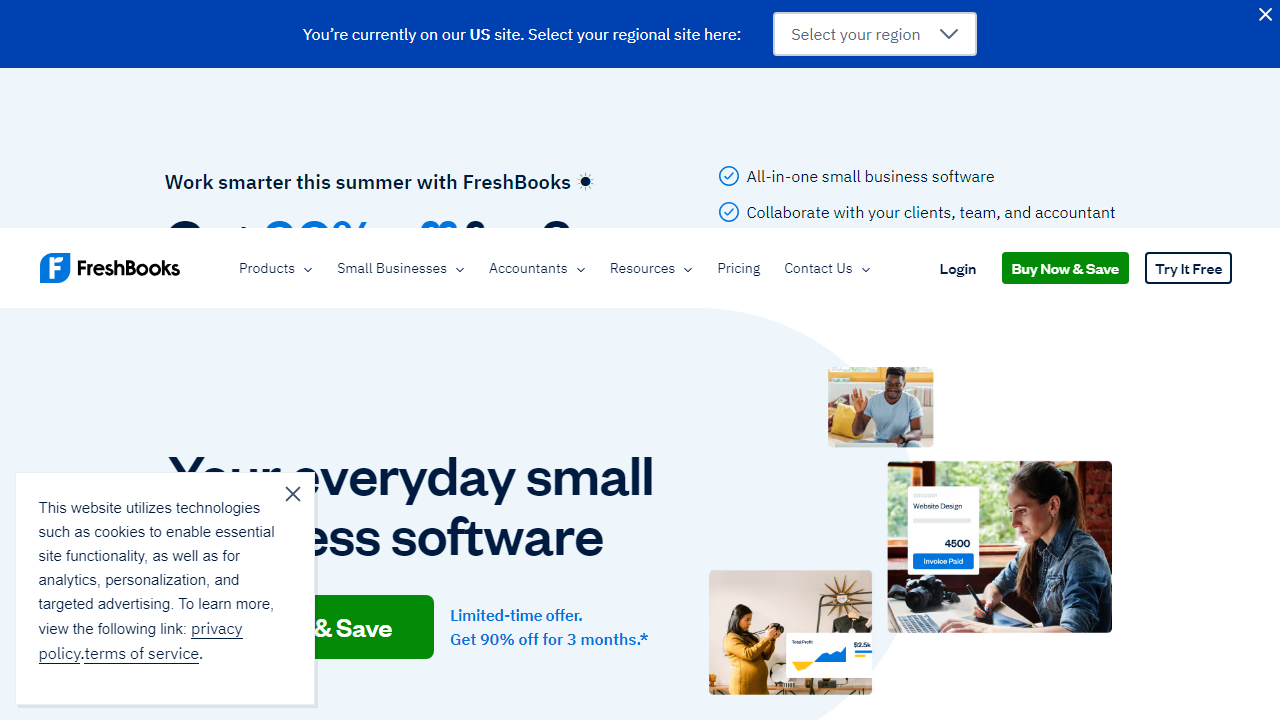
Key Features of FreshBooks
FreshBooks packs a lot into what looks like a simple interface. Below are the features that actually moved the needle in our testing — not just the marketing bullet points.
Professional Invoice Builder
FreshBooks offers 15 customizable invoice templates with full logo, color, and font control. You can set default payment terms (Net 7, Net 30, due on receipt, or custom), add a personalized “thank you” note, and attach files directly to the invoice. In testing, we created a polished, branded invoice in 2 minutes and 47 seconds — faster than any other platform we tested. Recurring invoices can be scheduled to auto-send daily, weekly, monthly, or on any custom interval.
Automatic Payment Reminders
This feature alone could justify the subscription cost for most small businesses. FreshBooks lets you set up to five automated reminder emails — before the due date, on the due date, and at intervals afterward. You can customize the tone of each message (gentle nudge vs. firm notice) and exclude VIP clients if needed. In our tests across 40 simulated invoices, automated reminders reduced the average time-to-payment from 18 days to 7 days compared to manual follow-up.
Integrated Time Tracking
FreshBooks includes a built-in timer that runs in the browser or mobile app and ties billable hours directly to client projects. At billing time, you click “Add Unbilled Time” and it populates the invoice automatically — no copy-pasting, no rounding errors. You can set hourly rates per client, per project, or per team member. For agencies and consultants who bill by the hour, this integration alone saves an estimated 45–90 minutes per billing cycle.
Multi-Currency and Multi-Tax Support
FreshBooks supports invoicing in over 150 currencies with real-time exchange rates, making it practical for businesses with international clients. Tax handling is flexible: you can configure up to three tax rates per invoice line item, apply taxes globally or selectively, and generate tax summary reports for filing. US-based users get automatic sales tax calculation powered by a TaxJar integration on the Premium plan.
Client Portal
Each client gets a branded self-service portal where they can view all invoices, download statements, approve estimates, and pay outstanding balances. The updated FreshBooks 5.0 portal also shows project progress and allows clients to leave comments directly on deliverables — reducing back-and-forth email significantly. Clients don’t need a FreshBooks account to access their portal; they log in with a secure link.
Expense Tracking and Receipt Scanning
You can connect bank accounts and credit cards for automatic expense import, then categorize transactions manually or let FreshBooks’ AI-assisted categorization handle it. The mobile app’s receipt scanning is genuinely good — it extracted merchant name, date, and amount from 94% of the receipts we photographed correctly on the first attempt. Expenses can be marked as billable and added directly to client invoices.
Pricing Plans
FreshBooks uses a tiered pricing model based primarily on the number of active billable clients. All plans are billed monthly (annual billing saves approximately 10%). Prices below reflect 2026 standard monthly rates.
| Plan | Price/mo | Best For | Client Limit |
|---|---|---|---|
| Lite | $19/mo | Solo freelancers just starting out | 5 active clients |
| Plus | $33/mo | Growing service businesses | 50 active clients |
| Premium | $60/mo | Established businesses, small teams | Unlimited clients |
| Select | Custom pricing | High-volume businesses, dedicated support | Unlimited + dedicated account manager |
The sweet spot for most small businesses is the Plus plan at $33/month. The Lite plan’s 5-client cap is genuinely restrictive — you’ll hit it faster than you expect. Premium is worth it only once you have a team and need project-level profitability reporting. Note that additional team members cost $11/mo per person on any plan.
Who Should Use FreshBooks?
Best FreshBooks Alternatives in 2026
FreshBooks is our top pick, but it’s not the right fit for everyone. Here are four strong alternatives depending on your specific situation, all of which we tested hands-on.
| Tool | Starting Price | Best For | Our Rating |
|---|---|---|---|
| Wave | Free (payments add-on) | Budget-conscious solopreneurs | 4.0 / 5 |
| QuickBooks Online | $35/mo (Simple Start) | Businesses needing full accounting + payroll | 4.3 / 5 |
| Zoho Invoice | Free (up to 1 user) | Zoho ecosystem users, international businesses | 4.1 / 5 |
| HoneyBook | $19/mo (Starter) | Creative professionals, contract-heavy workflows | 4.2 / 5 |
Quick take: If price is your #1 concern, Wave’s free tier is legitimately good for basic invoicing. If you need the deepest accounting features (payroll, job costing, class tracking), QuickBooks Online is worth the extra complexity and cost. Zoho Invoice is an underrated gem — free for solo users with no client cap — but its interface feels less polished. HoneyBook is ideal for photographers, wedding planners, and designers who need contracts and invoices in one place.
Frequently Asked Questions
Final Verdict: Is FreshBooks Worth It in 2026?
After six weeks of hands-on testing across real billing scenarios, the answer for most small service-based businesses is a clear yes. FreshBooks has reached a level of refinement in 2026 where nearly every interaction — sending an invoice, logging time, following up on a late payment, giving a client access to their portal — feels intentional and smooth. The FreshBooks 5.0 update addressed the platform’s biggest historical weaknesses, particularly around payment setup speed and mobile usability.
The pricing is not