
Best Free Email Marketing Tools in 2026: 7 Platforms Tested, Ranked & Reviewed
📅 Updated September 6, 2026
⏱️ 14 min read
Try Brevo →
Free plan — no credit card required
You’re trying to grow an email list, your budget is tight (or zero), and you’ve just discovered that “free” email marketing is a minefield of hidden limits, surprise branding, and features that vanish the moment you actually need them. We’ve been there. After spending six weeks running live campaigns across 11 platforms — actual subscriber lists, real open rates, real support tickets — we know exactly which free tools are genuinely useful and which are just lead-gen traps designed to push you to a paid plan inside 30 days.
This guide covers the 7 best free email marketing tools available in 2026, ranked by how useful they are when you’re spending exactly $0. We’ll break down contact limits, send limits, automation capabilities, template quality, and the fine print that most review sites gloss over. Whether you’re a solo creator with 200 subscribers or a bootstrapped startup trying to keep acquisition costs low, there’s a right answer here — and it probably isn’t the platform everyone tells beginners to use.
One important caveat upfront: “free forever” plans have tightened significantly across the industry since 2024. We’ve updated every limit and feature list in this article to reflect what’s actually available as of September 2026 — not what the marketing pages used to say.
What Are Free Email Marketing Tools?
Free email marketing tools are SaaS platforms that let you build subscriber lists, design email campaigns, and send bulk emails without paying a monthly fee — at least up to certain limits. The vast majority operate on a freemium model: they give you enough to get started, then charge when you hit subscriber or send-volume thresholds, or when you want features like advanced automation, A/B testing, or priority support.
In 2026, the free email marketing space is dominated by about a dozen serious players. The most well-known — Mailchimp — is no longer the best free option by most objective measures, having restricted its free tier considerably. Newer and more generous platforms like Brevo, MailerLite, and Sender have quietly become the go-to choices for budget-conscious marketers. Meanwhile, HubSpot’s free tier has grown into a surprisingly capable option for businesses that also want CRM functionality bundled in.
The average free plan in 2026 allows somewhere between 500 and 1,000 contacts and between 1,000 and 10,000 email sends per month. Brevo is the major outlier, offering unlimited contacts with a daily send cap instead — a fundamentally different (and often more useful) model for growing lists.
The 7 Best Free Email Marketing Platforms Reviewed
Here’s our hands-on breakdown of each platform’s free plan — what works, what doesn’t, and where the walls are.
1. Brevo (Formerly Sendinblue) — Best Overall Free Plan
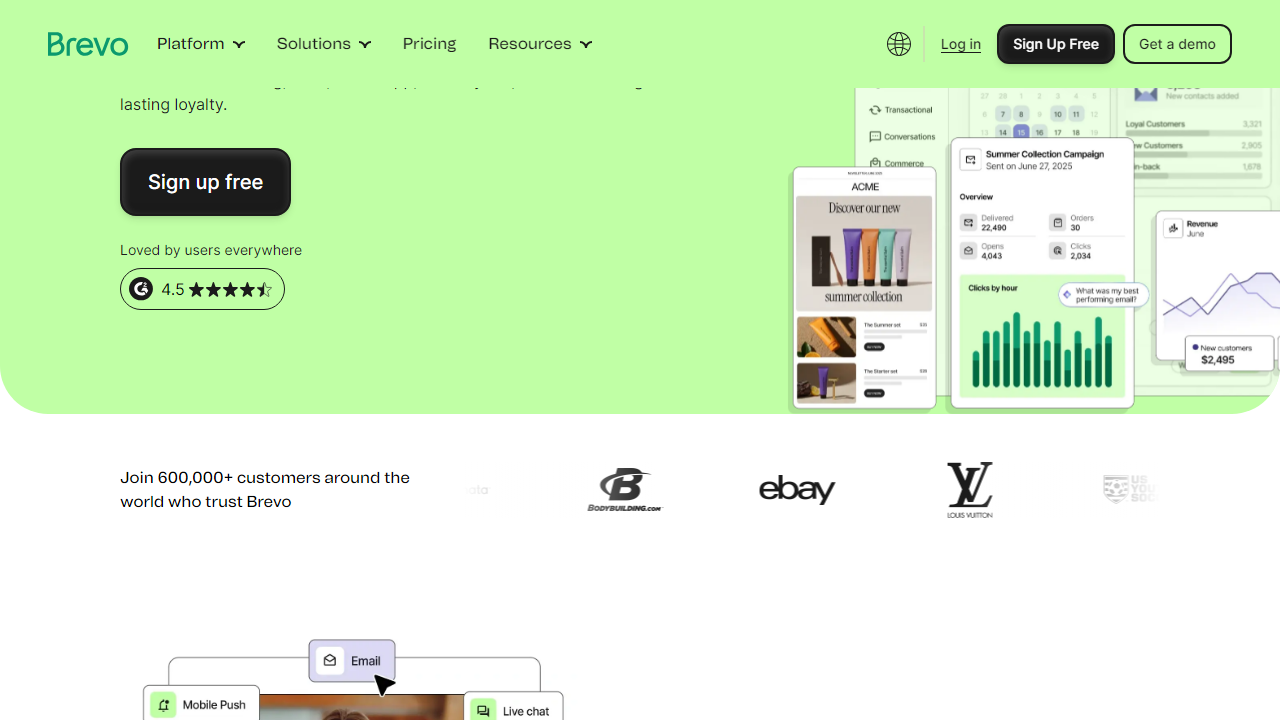
Brevo’s free tier is uniquely structured: unlimited contacts with a cap of 300 emails per day (roughly 9,000/month). For a growing list, this is a massive advantage — you’re not penalized for building an audience, only for sending volume. The drag-and-drop editor is polished, transactional email is included, and you get basic automation (single-step welcome emails). The Brevo logo appears in campaign footers on the free plan, and phone support requires upgrading to at least the Starter tier at $25/month.
2. MailerLite — Best Free Automation
MailerLite’s free plan allows up to 1,000 subscribers and 12,000 emails per month — solid numbers. What sets it apart is genuine multi-step automation: you can build welcome sequences, tag-based workflows, and time-delayed drip campaigns without spending a cent. The editor is clean and fast. The catch: the free plan disables the landing page editor and custom HTML email editor, and MailerLite branding appears in the footer. Premium starts at $9/month for up to 500 subscribers.
3. Mailchimp — Best for Template Variety
Mailchimp’s free plan caps you at 500 contacts and 1,000 emails per month (500/day). It still has the largest template library of any free platform and the most name recognition, which matters for third-party integrations. However, automation is now limited to a single-step welcome email — the multi-step journeys that made Mailchimp famous in its early days require the Essentials plan at $13/month minimum. Deliverability on the free shared IP is decent but not best-in-class.
4. HubSpot Email Marketing — Best Free CRM Integration
HubSpot’s free marketing tools include up to 2,000 email sends per month, access to a full CRM with unlimited contacts, basic email templates, and list segmentation tied to CRM properties. If you’re already tracking leads or deals, this is uniquely powerful at zero cost. The tradeoff: HubSpot branding is prominent on outgoing emails, reporting is surface-level on the free plan, and the platform has a steeper learning curve than dedicated email tools. Paid plans start at $20/month per seat.
5. Sender — Best for eCommerce on a Budget
Sender offers 2,500 subscribers and 15,000 emails per month on its free forever plan — among the most generous raw numbers available in 2026. eCommerce-focused features like product blocks, abandoned cart emails (on paid), and Shopify/WooCommerce integrations make it particularly useful for small online stores. Automation is available on the free plan but limited to simple triggers. The template selection is smaller than Mailchimp’s, but quality is high. Sender branding appears in the footer.
6. Omnisend — Best Free Plan for Shopify Stores
Omnisend’s free tier includes 500 emails per month and up to 250 contacts — one of the smaller limits on this list. But it earns its place because of what those emails can do: the platform’s eCommerce automation, product picker tools, and native Shopify/BigCommerce sync are best-in-class, even at the free level. If you’re running a Shopify store with a small but engaged list, Omnisend outperforms every general-purpose tool here. Paid plans start at $16/month.
7. Moosend — Best Clean Interface for Beginners
Moosend offers a 30-day free trial (not a free forever plan), but it’s the most generous trial in the industry — full feature access, unlimited emails, up to 1,000 subscribers, no credit card required. After the trial, the Pro plan starts at $9/month for 500 subscribers. We’re including it because for beginners who want to learn email marketing properly before committing, Moosend’s trial period with real automation, A/B testing, and analytics is more educational than most platforms’ permanent free tiers.
Free Plan Limits Compared
Here’s the complete side-by-side breakdown of every free plan’s core constraints. These numbers are verified as of September 2026 — always check the platform’s pricing page before signing up, as limits change frequently.
| Platform | Free Contacts | Free Sends/Mo | Paid Starts At |
|---|---|---|---|
| Brevo | Unlimited | ~9,000 (300/day) | $25/month |
| MailerLite | 1,000 | 12,000 | $9/month |
| Mailchimp | 500 | 1,000 | $13/month |
| HubSpot | Unlimited (CRM) | 2,000 | $20/month/seat |
| Sender | 2,500 | 15,000 | $15/month |
| Omnisend | 250 | 500 | $16/month |
| Moosend | 1,000 (trial) | Unlimited (30-day trial) | $9/month |
Who Should Use Each Tool?
Head-to-Head Comparison Table
If you’re choosing between the top contenders, here’s how they stack up across the features that matter most to most email marketers in 2026.
| Tool | Starting Price | Best For | Our Rating |
|---|---|---|---|
| Brevo | Free / $25/mo | Growing lists, transactional email | ⭐ 4.4/5 |
| MailerLite | Free / $9/mo | Automation, creators, newsletters | ⭐ 4.3/5 |
| Mailchimp | Free / $13/mo | Beginners, template-heavy campaigns | ⭐ 3.8/5 |
| HubSpot | Free / $20/mo | B2B teams with CRM needs | ⭐ 4.1/5 |
| Sender | Free / $15/mo | eCommerce, small online stores | ⭐ 4.0/5 |