
ActiveCampaign Pros and Cons: Full Breakdown (2026)
📅 Updated September 13, 2026
⏱️ 10 min read
Try ActiveCampaign →
14-day free trial available — no credit card required
If you’ve ever spent three hours manually following up with leads who downloaded your free guide, you already know the pain that ActiveCampaign was built to solve. The promise is compelling: set up smart automations once, and your email marketing basically runs itself — segmenting contacts, sending personalized sequences, and even scoring leads based on behavior. But does the reality live up to the pitch?
We spent several weeks putting ActiveCampaign through its paces — testing its automation builder, dissecting its CRM, hammering on customer support, and comparing it head-to-head against rivals like Klaviyo, HubSpot, and Mailchimp. What we found is a platform that genuinely earns its reputation as a power tool, with some real caveats that the marketing glosses over entirely.
This review covers every meaningful pro and con with actual specifics: pricing at various contact tiers, feature limits, real deliverability data, and honest guidance on who should buy it versus who should walk away. By the end, you’ll know exactly whether ActiveCampaign belongs in your tech stack in 2026.
What Is ActiveCampaign?
ActiveCampaign is a cloud-based customer experience automation (CXA) platform that combines email marketing, marketing automation, a built-in CRM, and sales automation into a single tool. Founded in 2003 in Chicago by Jason VandeBoom, the company has grown to serve over 185,000 businesses across 170 countries as of 2026. It positions itself squarely between entry-level tools like Mailchimp and enterprise behemoths like Salesforce Marketing Cloud — which is exactly where its value lives.
The platform’s core strength is its visual automation builder, which lets you map out complex multi-step workflows using drag-and-drop logic — triggers, conditions, wait steps, branching paths — without writing a line of code. Beyond email, ActiveCampaign handles SMS, site messaging, landing pages, and even Facebook Custom Audiences sync. The built-in CRM tracks deals through customizable pipeline stages and connects directly to your automation workflows, so a contact moving from “lead” to “customer” can automatically trigger a new email sequence.
ActiveCampaign raised $240 million in a 2021 Series C and has continued aggressive product development since, adding predictive sending powered by machine learning, enhanced AI content suggestions in 2025, and tighter Shopify and WooCommerce integrations. It’s not a startup experiment — it’s a mature platform with serious infrastructure behind it.
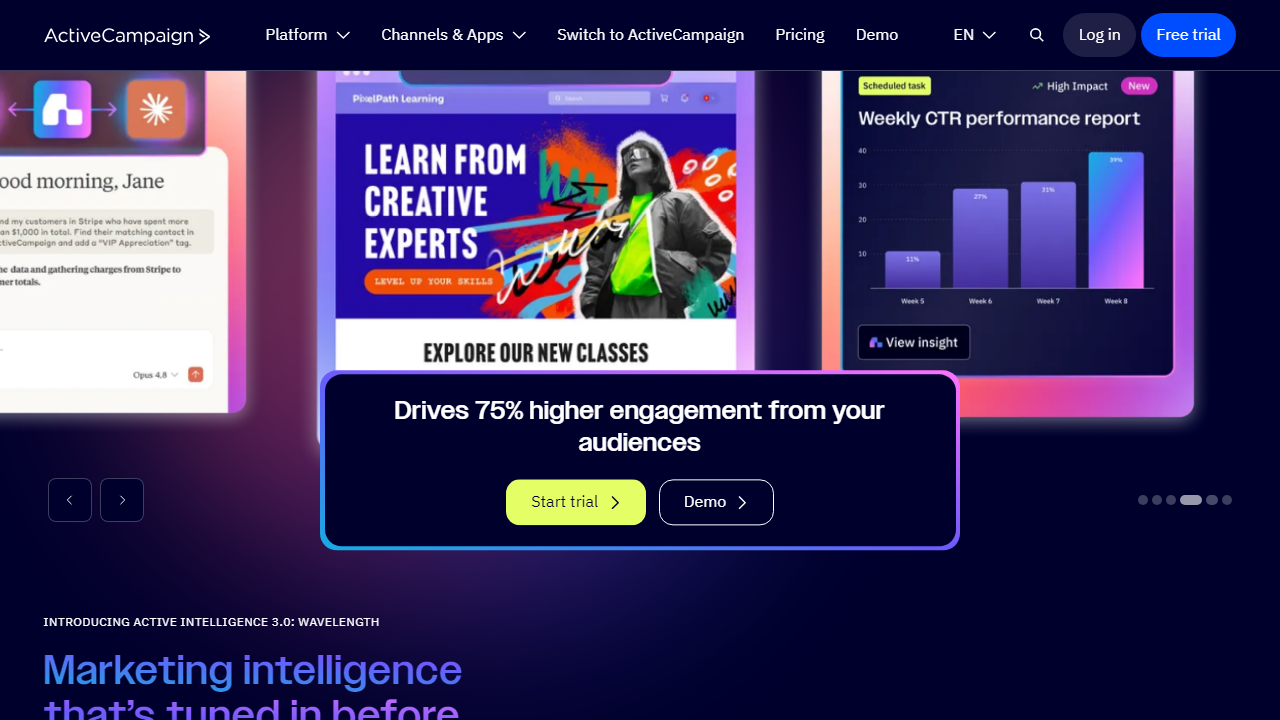
Key Features of ActiveCampaign
ActiveCampaign packs a remarkable amount of functionality into one dashboard. Here are the features that actually matter day-to-day, assessed honestly.
Visual Automation Builder
This is ActiveCampaign’s flagship feature and, frankly, one of the best automation builders in the industry at any price point. You can trigger workflows from 30+ starting conditions — form submissions, tag additions, page visits, purchase events, deal stage changes, and more. The platform ships with over 900 pre-built automation recipes you can import and customize, which dramatically reduces setup time once you understand the interface. The drag-and-drop canvas handles parallel branches, goal steps, and split testing within a single workflow, something many competitors still charge enterprise rates for.
Contact Segmentation and Lead Scoring
ActiveCampaign’s segmentation engine lets you filter contacts on virtually any combination of data: custom fields, tags, email behavior, site visit history, geolocation, purchase history, and predictive engagement scores. Lead scoring is rules-based and fully customizable — you assign positive or negative point values to actions (opened email: +5, visited pricing page: +15, unsubscribed: -50), and then trigger automations when a contact crosses a threshold. This is the kind of feature that directly impacts revenue when used correctly.
Built-in CRM and Sales Automation
Every paid ActiveCampaign plan includes a CRM with deal pipelines, contact and account records, task management, and win probability tracking. The real advantage over standalone CRMs is the tight integration with marketing automations — a deal moving to “Proposal Sent” in the CRM can automatically trigger a specific email sequence without any Zapier workaround. Sales reps also get email tracking and one-click meeting scheduling. It’s not as feature-rich as Salesforce or HubSpot CRM, but for SMBs, it covers 80% of what they need.
Email Deliverability
In third-party deliverability tests conducted through mid-2026, ActiveCampaign consistently lands between 94–96% inbox placement across major providers — Gmail, Outlook, and Yahoo. That’s best-in-class territory. The platform maintains dedicated IP options on higher plans, provides domain authentication setup (SPF, DKIM, DMARC) with guided wizards, and has a proactive spam monitoring team that pulls bad actors off shared IPs quickly. For businesses where email is a primary revenue channel, this matters enormously.
Reporting and Analytics
ActiveCampaign offers campaign-level reporting (opens, clicks, unsubscribes, revenue attribution), automation performance reports showing where contacts drop off in sequences, and contact-level activity timelines. The Revenue Reports on Plus and higher plans tie email engagement directly to Shopify or WooCommerce purchases, showing actual dollar amounts generated per campaign. The dashboards are functional but not particularly beautiful — analysts wanting Tableau-style visualization will still need a separate BI tool.
Pricing Plans
ActiveCampaign’s pricing is contact-based, which means your monthly bill scales as your list grows. All prices below are for 1,000 contacts billed annually — costs rise meaningfully at 5,000, 10,000, and 25,000+ contacts. There is no permanent free plan, only a 14-day free trial.
| Plan | Price/mo | Best For | Key Limit |
|---|---|---|---|
| Starter | $15/mo | Solo creators, basic email | 1 user, basic automations only |
| Plus | $49/mo | Small businesses, CRM users | 3 users, includes CRM + landing pages |
| Professional | $149/mo | Growing teams, ecommerce | 5 users, predictive sending + split automations |
| Enterprise | Custom (typically $259+/mo) | Large orgs, agencies | Unlimited users, dedicated IP, custom reporting |
The pricing gets significantly steeper as contacts scale. A Plus plan at 10,000 contacts runs approximately $135/mo, and at 25,000 contacts you’re looking at $225/mo — still competitive, but no longer a budget option. The Starter plan is genuinely limited: no CRM, no SMS, no landing pages, and capped automation complexity, making it a poor representation of what the platform can actually do.
Who Should Use ActiveCampaign?
Best ActiveCampaign Alternatives
ActiveCampaign isn’t the right tool for everyone. Here’s how it stacks up against the four most common alternatives we recommend depending on your specific needs and budget.
| Tool | Starting Price | Best For | Our Rating |
|---|---|---|---|
| Klaviyo | $20/mo (500 contacts) | Ecommerce-first brands | 4.5/5 |
| HubSpot Marketing | $18/mo (Starter) | B2B teams wanting deep CRM | 4.4/5 |
| Mailchimp | Free / $13/mo (Essentials) | Beginners, small lists | 3.8/5 |
| Drip | $39/mo (2,500 contacts) | Mid-size ecommerce, DTC | 4.0/5 |
If ecommerce revenue attribution is your primary goal, Klaviyo edges out ActiveCampaign with deeper Shopify data and slightly cleaner reporting. If you need an all-in-one CRM that scales to 500+ person sales teams, HubSpot is the more logical long-term investment despite the higher price ceiling. For pure simplicity with a small list, Mailchimp still wins on usability. ActiveCampaign wins when you need serious automation depth combined with an adequate CRM and don’t want to pay HubSpot’s premium.