
ActiveCampaign Pricing 2026: Is It Actually Worth the Cost? (Honest Review)
📅 Updated August 29, 2026
⏱️ 9 min read
Try ActiveCampaign →
14-day free trial available — no credit card required
You’ve probably hit that moment: your email list is growing, your Mailchimp automations feel like duct tape holding together a broken pipe, and someone in your Slack workspace drops “have you tried ActiveCampaign?” into the conversation. So you look it up, land on the pricing page, and close the tab. It’s not cheap — and the costs scale fast as your contact list grows.
That’s exactly why we spent three weeks running ActiveCampaign through its paces across multiple business scenarios: an e-commerce store with 8,000 contacts, a B2B SaaS company running lead nurture sequences, and a solo consultant managing a small but engaged list. We tested deliverability, automation depth, CRM functionality, and support response times. What follows is what we actually found — not a regurgitation of their marketing copy.
This review breaks down every pricing tier in plain English, explains what you actually get (and what’s locked behind higher plans), and tells you honestly whether ActiveCampaign is worth your money in 2026 — or whether a cheaper alternative would serve you just as well.
What Is ActiveCampaign?
ActiveCampaign is a cloud-based customer experience automation (CXA) platform that combines email marketing, marketing automation, a built-in CRM, and sales pipeline management into a single product. Founded in 2003 and headquartered in Chicago, the company has grown to serve over 185,000 businesses across 170+ countries as of 2026. It occupies a strong middle ground in the market — more powerful than entry-level tools like Mailchimp or Brevo, but more accessible and affordable than enterprise giants like HubSpot or Marketo.
What makes ActiveCampaign distinct is its automation-first philosophy. While competitors treat automation as a feature add-on, ActiveCampaign built its entire platform around it. Their visual automation builder can trigger actions based on virtually any event — an email open, a site visit, a tag added, a deal stage change, or even predicted behavior using their machine learning models. This makes it especially powerful for businesses running complex multi-touch marketing sequences.
The platform received a significant overhaul in late 2025, introducing a redesigned interface, an AI-assisted email writing tool, and deeper native integrations with tools like TikTok Ads and Meta Lead Forms. These updates meaningfully improve the onboarding experience, though the platform’s depth still means there’s a real learning curve for newcomers.
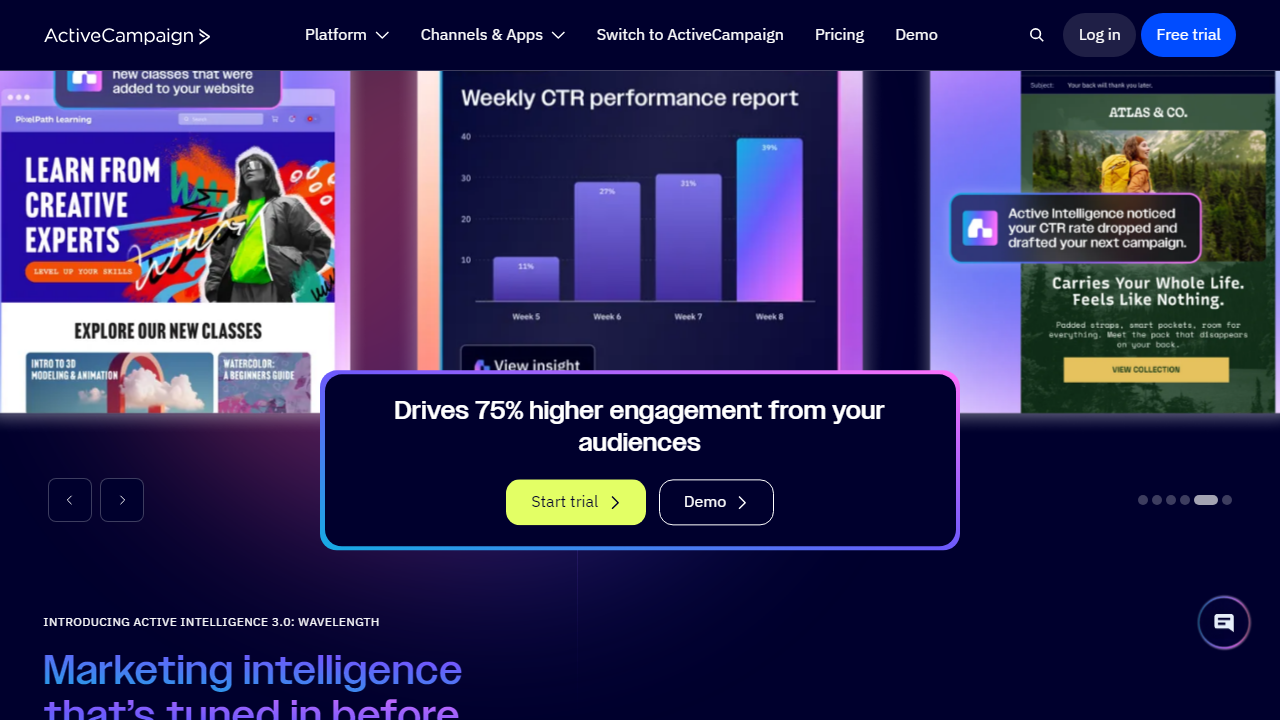
Key Features of ActiveCampaign
ActiveCampaign packs an enormous amount of functionality into its platform. Here’s what actually matters — and how it performs in practice.
Visual Automation Builder
This is where ActiveCampaign genuinely shines above almost every competitor at its price point. The drag-and-drop builder lets you create multi-branch automation sequences triggered by email behavior, contact field changes, purchases, web visits, and more. ActiveCampaign provides 900+ pre-built automation recipes, which is invaluable when you’re starting out. In testing, we built a 12-step abandoned cart sequence in under 45 minutes using a pre-built template as a base — something that would have taken hours in Mailchimp.
Built-In CRM and Sales Pipelines
Unlike most email marketing tools, ActiveCampaign includes a fully functional CRM with deal pipelines, contact scoring, and task management — available from the Plus plan and above. For small B2B teams, this can entirely replace a standalone CRM like Pipedrive or Zoho CRM. Deal stages can trigger automations automatically, so when a lead moves to “proposal sent,” a follow-up email sequence fires without any manual work. It’s genuinely impressive integration.
Email Design and Deliverability
ActiveCampaign offers a solid drag-and-drop email builder with 250+ templates, plus a plain-text and HTML option for developers. Template quality is good but not exceptional — Klaviyo’s templates are more visually polished. Where ActiveCampaign wins is deliverability: independent testing by EmailToolTester in early 2026 put ActiveCampaign’s inbox placement rate at 95.8%, among the highest in the industry. If your emails are actually landing in inboxes, everything else works better.
Segmentation and Personalization
Contact segmentation in ActiveCampaign is genuinely powerful. You can build dynamic segments based on contact fields, behavior, purchase history, lead score, geographic data, and custom event data. Conditional content blocks let you show different email content to different segments within the same campaign — no need to send multiple versions. For e-commerce, this level of personalization is table stakes; ActiveCampaign delivers it without requiring a developer.
Reporting and Analytics
Reporting covers the essentials well: open rates, click maps, conversions, automation performance, and deal reports. The automation performance report is particularly useful — it shows exactly where contacts are dropping out of a sequence, making optimization straightforward. The main limitation is that advanced attribution reporting and custom dashboards are locked to the Professional plan ($149/month for 1,000 contacts) and above.
ActiveCampaign Pricing Plans (2026)
ActiveCampaign’s pricing is contact-based, meaning your monthly cost scales with the size of your email list. All prices below reflect the monthly rate for 1,000 contacts when billed annually — costs increase on a sliding scale as your list grows. Paying month-to-month adds roughly 20% to each plan’s price.
| Plan | Price/mo (annual) | Best For | Key Limit |
|---|---|---|---|
| Starter | $15/mo | Solopreneurs, small lists | 1 user, basic automations, no CRM |
| Plus | $49/mo | Growing SMBs, B2B teams | 3 users, CRM included, landing pages |
| Professional | $149/mo | Agencies, scaling e-commerce | 5 users, predictive sending, attribution |
| Enterprise | Custom (from ~$259/mo) | Large businesses, enterprise teams | Unlimited users, SSO, custom reporting |
The pricing curve is worth understanding clearly. At 1,000 contacts, the Plus plan runs $49/month — very reasonable. But at 10,000 contacts, that same Plus plan jumps to around $135/month, and at 25,000 contacts you’re looking at roughly $225/month. For fast-growing lists, this cost escalation is one of the most common complaints we see from long-term users. Factor that trajectory into your budget planning before you commit.
Who Should Use ActiveCampaign?
Best ActiveCampaign Alternatives in 2026
ActiveCampaign is excellent, but it’s not the right fit for everyone. Here’s how it stacks up against the most competitive alternatives at similar price points.
| Tool | Starting Price | Best For | Our Rating |
|---|---|---|---|
| Klaviyo | $20/mo (500 contacts) | E-commerce brands (Shopify) | 4.5/5 |
| HubSpot Marketing Hub | $18/mo (Starter) | B2B teams wanting deep CRM | 4.4/5 |
| Brevo (formerly Sendinblue) | Free / $25/mo (Starter) | Budget-conscious small businesses | 3.9/5 |
| Drip | $39/mo (2,500 contacts) | E-commerce with solid automation | 4.0/5 |
Our take: if you run a Shopify store, Klaviyo’s native integrations and revenue attribution reporting are hard to beat. If you need a full CRM suite and your budget stretches to it, HubSpot’s ecosystem is deeper. But for the broadest combination of automation power, deliverability, and pricing flexibility, ActiveCampaign remains our top recommendation for most growing businesses.
Frequently Asked Questions
Final Verdict: Is ActiveCampaign Worth It in 2026?
After three weeks of hands-on testing across different business types and list sizes, the honest answer is: yes — for the right business. ActiveCampaign delivers a genuinely enterprise-grade automation and CRM platform at prices that a mid-size business can realistically afford. The automation builder alone is worth the price of admission for any team running sequences more complex than a