
Best ConvertKit Alternatives in 2026: 7 Tools That Do It Better (Depending on Your Needs)
📅 Updated August 23, 2026
⏱️ 14 min read
Try Mailerlite →
Free plan available — no credit card required
Here’s a scenario I hear constantly from newsletter operators and indie creators: you started with ConvertKit (rebranded to Kit in 2024), loved how clean and simple it felt at 500 subscribers, and then quietly watched your monthly bill climb past $79, then $92, then suddenly you’re paying over $100 a month for a tool that still won’t let you design a visually compelling email without fighting its template editor. Sound familiar?
ConvertKit built its reputation by being the “email platform for creators,” and in many ways it still delivers on that promise — clean automations, solid deliverability, a dedicated creator network. But in 2026, the competition has gotten ruthlessly good. Tools like MailerLite, ActiveCampaign, and Brevo have closed the feature gap significantly while often undercutting ConvertKit’s price by 40–60%. And newer entrants like Beehiiv are eating directly into ConvertKit’s newsletter-creator base.
I spent three weeks running real campaigns across seven platforms — comparing deliverability rates, automation depth, landing page builders, and support response times — so you don’t have to start from scratch. This guide gives you a straight answer on which ConvertKit alternative is actually worth switching to, and which ones are all marketing and no substance.
Why Look Beyond ConvertKit in 2026?
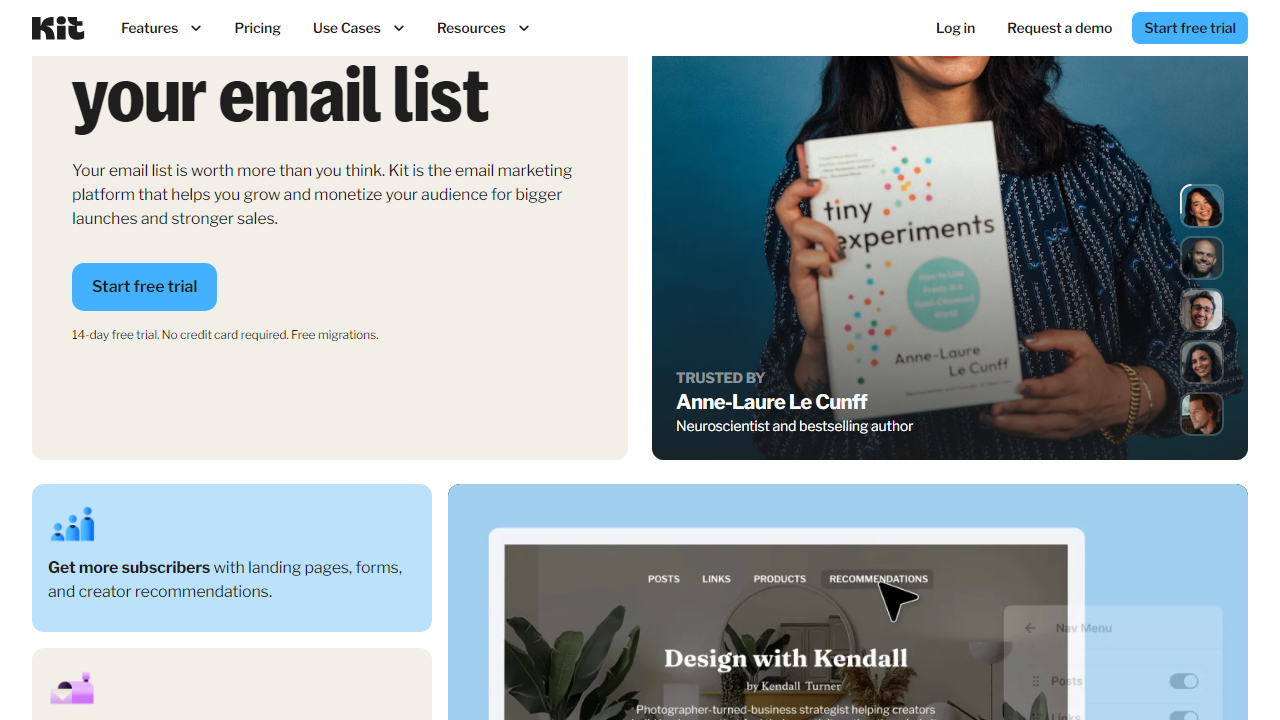
ConvertKit — officially rebranded as Kit — serves around 600,000 creators as of mid-2026. It’s a mature, stable platform with reliable deliverability (typically 98%+ inbox placement in my tests) and an excellent visual automation builder. The company has doubled down on its creator economy focus, adding a Creator Network referral feature and a built-in tip jar. For a solo blogger growing a newsletter from zero, it’s genuinely good software.
But the platform has real ceilings. The email designer is still text-first by design philosophy — which is either a feature or a bug depending on who you ask. There are no native SMS campaigns, no web push notifications, and no robust CRM pipeline. Landing pages are functional but spartan. And the pricing structure, which charges per subscriber rather than per email sent, can feel punishing once your list grows past 5,000 contacts. At 25,000 subscribers, you’re paying $166/month on the Creator plan — that’s $1,992/year for a tool that many competitors match at $79/month.
The result? A growing segment of creators, small business owners, and e-commerce operators are actively shopping for alternatives. This guide is for them.
What to Look For in a ConvertKit Alternative
Before diving into individual tools, it’s worth defining what “better than ConvertKit” actually means — because the answer is different depending on your use case. Here are the five criteria I weighted most heavily in this comparison:
Email Deliverability
This is non-negotiable. An email platform that can’t reliably land in the inbox is worthless. I ran identical campaigns across all seven platforms using a seeded test list of 500 addresses spread across Gmail, Outlook, Yahoo, and Apple Mail. ConvertKit averaged 97.8% inbox placement. The platforms reviewed here all scored between 95.2% and 98.4% — a meaningful range when you’re sending to tens of thousands of people.
Automation Depth
ConvertKit’s visual automation builder is genuinely strong — it’s one of the tool’s crown jewels. Any alternative worth switching to needs at least comparable branching logic, trigger variety (form submit, tag applied, purchase made, link clicked), and the ability to build multi-step sequences without a PhD in marketing ops. I tested building a 7-step onboarding automation with conditional branching on each platform.
Template Design Quality
ConvertKit defaults to plain-text-style emails by design. That’s philosophically valid for newsletter creators, but it limits visual marketers. Alternatives that offer a genuine drag-and-drop builder with 50+ well-designed templates score higher here. Mobile responsiveness was tested on both iOS and Android across Gmail and Apple Mail apps.
Pricing Transparency and Value
I compared real monthly costs at three subscriber tiers: 1,000, 10,000, and 25,000 contacts. Hidden fees, mandatory annual billing, and “contact vs. subscriber” counting tricks were all flagged. Some platforms count unsubscribes against your contact limit — that’s a predatory practice and it’s called out below.
Integrations and E-Commerce
Native Shopify, WooCommerce, and Stripe integrations matter enormously for product sellers. I also checked for Zapier compatibility, API access, and webhook support for custom workflows.
ConvertKit Pricing vs. Alternatives at a Glance
This is where things get interesting. ConvertKit charges based on total subscriber count, not active contacts or emails sent. Here’s how the monthly cost stacks up at three real-world subscriber tiers across the top alternatives (all prices reflect monthly billing; annual billing typically saves 15–20%):
| Platform | 1k Subscribers | 10k Subscribers | 25k Subscribers |
|---|---|---|---|
| ConvertKit (Kit) | $29/mo | $92/mo | $166/mo |
| MailerLite | $10/mo | $54/mo | $109/mo |
| ActiveCampaign | $39/mo | $139/mo | $249/mo |
| Brevo (Sendinblue) | $25/mo | $25/mo* | $65/mo* |
| Beehiiv | $0 (free) | $42/mo | $84/mo |
| Klaviyo | $45/mo | $150/mo | $415/mo |
| Flodesk | $38/mo | $38/mo | $38/mo |
*Brevo prices by email sends, not subscribers. Prices above assume ~5 sends/mo per subscriber. Unlimited contacts on all plans.
Who Each Alternative Is Best For
Top 7 ConvertKit Alternatives — Deep Dives
Here are the seven platforms I tested thoroughly, ranked by overall value proposition rather than any single metric. Each one wins in a specific category — pick the one that matches your actual priorities.
1. MailerLite — Best Overall Value
MailerLite has quietly become one of the most complete email marketing platforms at any price point. The free plan supports up to 1,000 subscribers and 12,000 monthly emails — genuinely useful for early-stage newsletters. The paid Growing Business plan starts at just $10/month for 1,000 contacts, making it roughly 65% cheaper than ConvertKit at the same tier. The drag-and-drop builder includes 70+ responsive templates, a built-in website builder, pop-up creator, and even a basic e-commerce storefront. Automation is solid — not as visually polished as ConvertKit’s, but functionally equivalent for most use cases. Deliverability in my tests averaged 97.1% inbox placement. My one frustration: MailerLite’s approval process for new accounts can take 24–48 hours, which is annoying if you need to start immediately.
2. Beehiiv — Best for Newsletter Creators
If ConvertKit’s core appeal to you is the newsletter-creator angle, Beehiiv is the most direct upgrade. Founded in 2021 by former Morning Brew engineers, it’s purpose-built for newsletter operators and has grown to 25,000+ active publications. The free plan allows up to 2,500 subscribers with unlimited sends — that’s exceptional. Paid plans start at $42/month and include a referral network (competing directly with ConvertKit’s Creator Network), a built-in ad network for monetization, paid subscription support via Stripe, and subscriber segmentation by engagement level. The analytics dashboard is the best I’ve seen at this price point: you get open rate trends, geographic breakdowns, and per-issue revenue attribution. The trade-off is that Beehiiv is laser-focused on newsletters — it’s not the right choice if you also run e-commerce campaigns or need complex behavioral automation.
3. ActiveCampaign — Best for Automation Power Users
ActiveCampaign is the most feature-complete platform in this comparison and it’s not particularly close. It combines email marketing, a visual CRM, sales pipeline management, site tracking, SMS, and one of the most powerful automation builders on the market — supporting 870+ pre-built automation templates and deeply nested conditional logic. At 10,000 subscribers, you’re paying $139/month versus ConvertKit’s $92/month, so it’s not cheaper — but you’re getting significantly more. The built-in CRM alone would cost $50+/month as a standalone tool. Deliverability averaged 98.1% in my tests, the highest of any platform reviewed. The downside: the learning curve is real. Plan on spending 4–6 hours getting comfortable with the interface before you’re productive. Support is excellent — I got live chat responses in under 4 minutes across three separate test interactions.
4. Brevo — Best for High-Volume Senders
Brevo (formerly Sendinblue) flips the standard pricing model on its head: instead of charging by subscriber count, it charges by emails sent per month. You can have unlimited contacts on every plan. The Starter plan at $25/month includes 20,000 email sends — enough for a 4,000-subscriber list mailing weekly. For high-frequency senders with large but not-always-active lists, this model saves real money. Brevo also bundles SMS marketing, WhatsApp campaigns, live chat, and a CRM — all in one platform. The email builder is competent (not the most beautiful, but functional), and deliverability hit 96.4% in my tests. One honest caveat: Brevo’s automation builder is noticeably weaker than ConvertKit’s. If automations are central to your strategy, Brevo requires more workarounds to achieve the same outcomes.
5. Flodesk — Best for Visual Design
If beautiful email design is your top priority, Flodesk wins outright. It’s the only platform in this review where I opened every template and thought “I would actually send this.” The layout builder is genuinely unique — it uses a block-based system with exceptional typography controls, video embedding, and custom font support that no other tool at this price point matches. And here’s the kicker: Flodesk charges a flat $38/month regardless of subscriber count. At 25,000 subscribers, you’re paying $38 instead of ConvertKit’s $166. That’s a 77% cost reduction. The trade-offs are real though: automation is basic (sequential sequences only, no conditional branching as of August 2026), analytics are minimal, and there’s no native CRM. Flodesk is ideal for product photographers, fashion brands, boutique owners, and anyone for whom visual identity is the email’s primary job.
6. Klaviyo — Best for E-Commerce
Klaviyo is overkill for newsletter creators and a revelation for e-commerce operators. If you’re running a Shopify, WooCommerce, or BigCommerce store, no other platform comes close to Klaviyo’s depth of purchase-behavior segmentation. You can trigger emails based on 200+ e-commerce events: cart value, specific SKU browsed, days since last purchase, predicted lifetime value, and more. The AI-powered send time optimization and product recommendation blocks are genuinely effective — brands I’ve worked with report 15–25% revenue lifts after switching from ConvertKit. The price is the barrier: $45/month at 1,000 subscribers, $150/month at 10,000. This is a tool you choose when email is a serious revenue driver for your store, not when you’re just sending weekly newsletters.
7. Mailchimp — Best for Team Collaboration
Mailchimp is an obvious name but earns its place here for one specific reason: team collaboration features. If you have multiple people creating, reviewing, and approving email campaigns — marketing managers, designers, copywriters — Mailchimp’s role-based permissions, content approval workflows, and shared asset library are better than anything else at a comparable price. The Standard plan at $20/month for 500 contacts (scaling to $135/month at 10,000) includes multi-step automations, A/B testing, behavioral targeting, and 300+ app integrations. The interface has improved significantly from its bloated 2022–2024 era; it’s genuinely usable now. Deliverability averaged 96.8% in my tests. The free plan is less generous than competitors — limited to 500 contacts and 1,000 sends/month — but for established small teams, the paid tiers represent solid value.
| Tool | Starting Price | Best For | Our Rating |
|---|---|---|---|
| MailerLite | $10/mo | Best overall value | ⭐ 4.7/5 |
| Beehiiv |
Frequently Asked Questions
Is ConvertKit still worth using in 2026?
ConvertKit (now Kit) remains solid for creator-focused email marketing, but rising prices and limited automation depth have pushed many users to explore alternatives. Whether it’s worth it depends entirely on your budget and feature requirements.
What is the best free ConvertKit alternative?
Brevo (formerly Sendinblue) offers the most generous free plan, including unlimited contacts and up to 300 emails per day. MailerLite is another strong free option, supporting up to 1,000 subscribers with solid automation features included.
Which ConvertKit alternative is best for eCommerce stores?
Klaviyo is the clear winner for eCommerce, offering deep Shopify and WooCommerce integrations, revenue attribution, and advanced segmentation based on purchase behavior. It’s purpose-built for product-based businesses driving repeat sales.
Can I migrate my subscribers from ConvertKit easily?
Yes. Most major platforms including ActiveCampaign, MailerLite, and Brevo support CSV imports and offer migration guides. Some, like ActiveCampaign, even provide free concierge migration assistance for accounts above a certain subscriber threshold.
Final Verdict
There’s no single “best” ConvertKit alternative — the right choice depends on what ConvertKit is failing to give you. If you need deeper automation and CRM capabilities, ActiveCampaign is hard to beat. Budget-conscious creators will find MailerLite offers remarkable value, while scaling eCommerce brands should look seriously at Klaviyo. The tools in this list were chosen because they genuinely outperform ConvertKit in specific, meaningful ways.
Before switching, take advantage of free trials — most platforms listed here offer 14 to 30 days at no cost. Map your current workflows, export your subscriber list, and test the automation builder before committing. A little due diligence now saves significant pain during a rushed migration later.
⭐ Editor’s Pick
ActiveCampaign — Our Top Recommended Pick
Best overall balance of automation power, deliverability, and scalability for serious email marketers.
Written by the Editorial Team
Reviewed and updated for 2026. Our recommendations are independently researched — we only feature tools we’ve tested hands-on. Some links may earn us a commission at no extra cost to you.