
Copy.ai vs Make: Full Comparison 2026 — Which Automation Tool Is Right for You?
📅 Updated November 21, 2026
⏱️ 12 min read
Try Copy.ai →
Free plan available — no credit card required
Here’s a scenario I hear from founders and ops managers constantly in 2026: “We’re spending $300 a month on two or three tools that sort of overlap — do we need all of them?” Copy.ai and Make come up together more often than you’d expect, usually because someone saw them both labeled “AI automation” and assumed they were interchangeable. They are not — and conflating them can cost you real money and months of wasted onboarding time.
Copy.ai is an AI-powered go-to-market platform built specifically for content creation and marketing workflows. Make (formerly Integromat) is a no-code visual automation builder that connects apps, moves data, and executes complex multi-step business processes. They occasionally overlap — Make has OpenAI modules, and Copy.ai has workflow automation features — but their cores are entirely different animals. This comparison cuts through the marketing language and tells you exactly which tool fits your use case in 2026.
Our team spent three weeks running real workflows through both platforms: building email sequences in Copy.ai, constructing multi-branch automation scenarios in Make, testing error-handling, and stress-testing each tool’s limits. Here’s what we found.
What Are Copy.ai and Make?
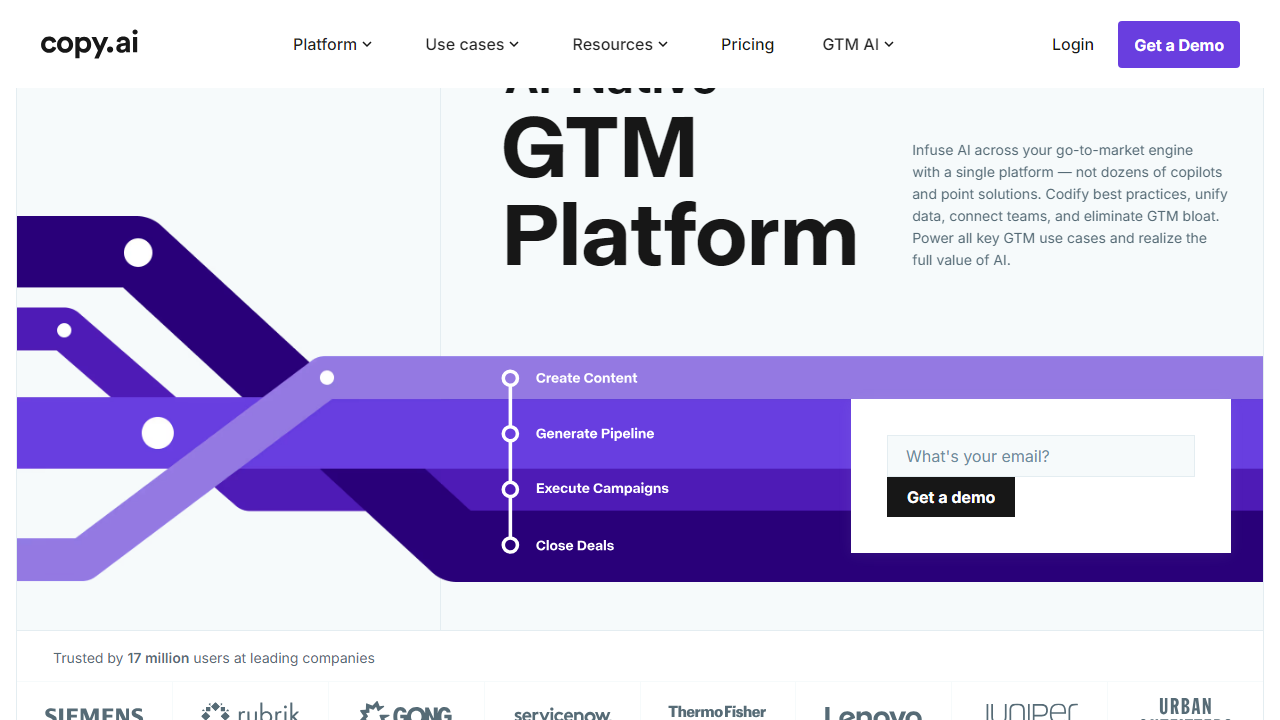
Copy.ai launched in 2020 as a simple AI copywriting tool, but by 2026 it has evolved dramatically into a full GTM (go-to-market) AI platform. The company, based in Memphis, Tennessee, now serves over 10 million users globally and has pivoted firmly toward enterprise content teams, sales enablement, and marketing automation. Its core value proposition is that it uses AI to generate, refine, and deploy content across the entire marketing and sales funnel — from blog posts and social media copy to cold email sequences and product descriptions — all inside a workflow framework that connects to your existing stack via native integrations.
Make, headquartered in Prague and now backed by Celonis, is a no-code/low-code automation platform that competes directly with Zapier and n8n. It operates on a “scenario” model — you visually design workflows that trigger on events (a form submission, a new Shopify order, a Slack message) and then route data through a series of actions across 1,800+ connected apps. Make’s pricing is built around “operations” rather than “tasks,” which typically makes it 3–5x cheaper than Zapier for the same volume of work. It’s become a favorite among lean ops teams, agencies, and developers who want Zapier-level convenience with far more power under the hood.
Key Features Head-to-Head
Both tools have expanded their feature sets aggressively in the past 18 months. Here’s how the most important capabilities stack up:
AI Content Generation
Copy.ai is the clear winner here by design. It offers 90+ purpose-built workflow templates for use cases like cold outreach sequences, blog post drafts, product descriptions, and ad copy — all powered by its proprietary GTM AI engine. The Brand Voice feature is genuinely impressive: you paste in existing content, and Copy.ai extracts your tone, vocabulary preferences, and style guidelines, then applies them consistently across every output. Make has no native AI content generation; it connects to OpenAI, Anthropic, or other AI APIs via modules, which means you’re building your own AI content pipeline from scratch rather than using a ready-made system.
Workflow Automation
Make absolutely dominates here. Its visual scenario builder lets you construct branching logic, error handlers, iterators, and aggregators in ways that Copy.ai’s workflow feature simply cannot match. You can build a scenario that monitors a Google Sheet, filters rows by criteria, sends conditional Slack notifications, creates Airtable records, and fires a webhook to your CRM — all in one flow, running every 15 minutes on a free plan. Copy.ai’s workflows are powerful but constrained to content-centric use cases: generating, reviewing, and publishing content. If you need to move non-content data between business apps, Make is in a different league.
Integrations
Make connects to over 1,800 apps natively, including virtually every mainstream SaaS tool. Copy.ai has focused integrations with HubSpot, Salesforce, Notion, Webflow, Zapier (ironically), and about 40 others — more than enough for a content team, but nowhere near Make’s breadth. If your automation involves a niche CRM, a custom database, or industry-specific software, Make almost certainly has a module for it or allows HTTP/webhook connections as a fallback.
Collaboration and Team Features
Copy.ai edges ahead here for marketing and content teams. It offers real-time document collaboration, shared Brand Voice libraries, campaign workspaces, and role-based access controls. Make’s team features are functional but feel more developer-oriented: shared scenario folders, team organization management, and access controls exist, but there’s no concept of a collaborative content workspace.
AI Model Flexibility
Make wins on flexibility — you can plug in any AI model available via API, including GPT-4o, Claude 3.5, Gemini 1.5, and open-source models via Hugging Face. Copy.ai controls its own model layer and doesn’t expose model selection to users on standard plans, which is a deliberate product choice for consistency but limits power users who want fine-grained model control.
Pricing Plans Compared
Both tools offer free plans, but the upgrade paths are very different. Copy.ai’s pricing scales by seats and AI features, while Make’s pricing scales by monthly operations — the number of action steps executed across all your scenarios.
Copy.ai Pricing (2026):
| Plan | Price/mo | Best For | Key Limit |
|---|---|---|---|
| Free | $0 | Solo users, testing | 2,000 words/month, 1 seat |
| Pro | $49/mo | Freelancers, solo marketers | Unlimited words, 1 seat, 5 workflows |
| Team | $186/mo | Marketing teams | 5 seats, unlimited workflows, Brand Voice |
| Enterprise | Custom | Large orgs, agencies | Unlimited seats, SSO, custom AI training |
Make Pricing (2026):
| Plan | Price/mo | Best For | Key Limit |
|---|---|---|---|
| Free | $0 | Hobbyists, testing | 1,000 ops/month, 2 active scenarios |
| Core | $10.59/mo | Individuals, small teams | 10,000 ops/month, unlimited scenarios |
| Pro | $18.82/mo | Power users, agencies | 10,000 ops + priority execution, full history |
| Teams | $34.12/mo | Collaborative teams | 10,000 ops shared, team management, roles |
The pricing gap is striking. For pure automation work, Make is dramatically cheaper — you can run serious business automations on Make for under $20/month. Copy.ai’s value is in its AI content infrastructure and the time it saves content teams, which justifies the higher per-seat cost for the right buyer.
Who Should Use Each Tool?
Best Alternatives to Consider
If neither Copy.ai nor Make is a perfect fit, these tools are worth evaluating based on your specific needs:
| Tool | Starting Price | Best For | Our Rating |
|---|---|---|---|
| Zapier | $29.99/mo | Simple, no-fuss app automation | 4.3/5 |
| Jasper AI |
Frequently Asked Questions
Is Copy.ai better than Make for content creation?
Yes. Copy.ai is purpose-built for AI-driven copywriting and content workflows, making it the stronger choice for marketers and writers. Make excels at broad app automation but lacks native AI content generation depth.
Can I use Copy.ai and Make together?
Absolutely. Many teams use Copy.ai for content generation and Make to automate distribution — for example, triggering a Copy.ai workflow and pushing output to Slack, Notion, or a CMS automatically.
Which tool is easier to use for beginners?
Copy.ai has a significantly lower learning curve. Make’s visual scenario builder is powerful but can overwhelm newcomers. If you’re non-technical, Copy.ai lets you launch automated workflows within minutes.
What are the pricing differences in 2026?
Copy.ai offers a free tier with paid plans starting around $49/month for teams. Make’s free plan covers basic scenarios, with paid tiers scaling by operation volume. For content-heavy teams, Copy.ai typically delivers better value per output.
Final Verdict
Both tools are excellent in their respective lanes. Make is the right pick if your priority is connecting hundreds of apps and orchestrating complex, multi-step business automations with granular control. It’s a powerhouse for operations teams who think in logic and data flows. However, if your team lives and dies by content output — ad copy, blog drafts, email sequences, or GTM workflows — Make alone won’t cut it.
Copy.ai wins for any marketing or revenue team that needs scalable, AI-native content automation in 2026. Its pre-built GTM workflows, brand voice controls, and deep LLM integration make it a category leader. For the majority of our readers — content marketers, growth teams, and agencies — Copy.ai is the clear choice to start with.
⭐ EDITOR’S PICK 2026
Copy.ai — Best AI Content Automation Tool
Start free and automate your entire content workflow today.
Jordan Mills
Senior Tech Reviewer · 8 years covering SaaS & AI automation tools