
Ahrefs Review 2026: Honest Look at the #1 SEO Tool (Is It Still Worth It?)
📅 Updated November 1, 2026
⏱️ 12 min read
Try Ahrefs →
Starter plan from $29/mo — no free trial but 7-day access for $7
If you’ve ever stared at a competitor’s website ranking above yours and wondered exactly how they got there — their backlinks, their top pages, their keyword strategy — Ahrefs is the tool that answers those questions faster and more accurately than anything else on the market. It’s the Swiss Army knife that SEO professionals actually reach for first.
We spent three weeks putting Ahrefs through its paces across multiple live client sites in 2026, stress-testing everything from its crawler limits to its AI-assisted content features. What we found is a platform that has only gotten stronger since our last review — but one that has also made some deliberate pricing decisions that will frustrate smaller operators. This review breaks down every major feature, every pricing tier, and tells you honestly who should pay for it and who shouldn’t.
Whether you’re an in-house SEO manager at a mid-size e-commerce brand, a freelance consultant juggling a dozen clients, or a content team lead trying to justify a five-figure annual software budget, we’ve got you covered with specifics — not vague praise.
What Is Ahrefs?
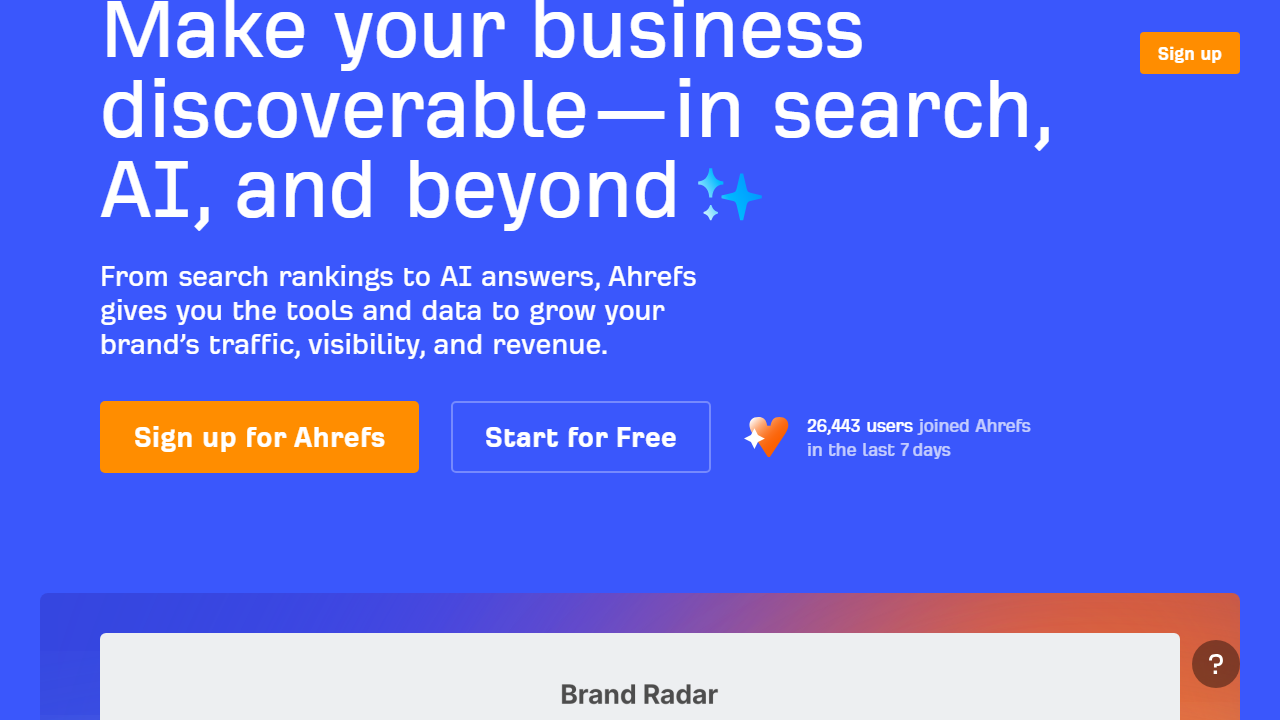
Ahrefs is a Singapore-based SEO software company founded in 2011 by Dmitry Gerasimenko. What started as a backlink analysis tool has evolved into a full-suite SEO platform covering keyword research, site auditing, rank tracking, content analysis, and competitor intelligence. As of 2026, Ahrefs claims to crawl over 8 billion web pages per day and maintains a live backlink index of more than 35 trillion links — the largest publicly available index of its kind.
The company is notably bootstrapped and has never taken outside investment, a fact that shapes its product philosophy. Ahrefs consistently prioritizes data quality over flashy UI redesigns and tends to roll out features methodically rather than rushing them to market. The result is a platform that feels dense and serious — not particularly fun to look at, but remarkably deep once you know where to click. They serve an estimated 200,000+ paying customers globally, including teams at Apple, Adobe, LinkedIn, and eBay.
In 2025 and into 2026, Ahrefs has invested heavily in AI-assisted features — most notably an AI content grader and AI-generated SERP summaries inside Keywords Explorer — while also expanding its free Ahrefs Webmaster Tools product, which has become a legitimate option for small site owners who just need basic crawl and backlink data without paying for a full subscription.
Key Features of Ahrefs
Ahrefs is built around five core tools: Site Explorer, Keywords Explorer, Site Audit, Rank Tracker, and Content Explorer. Each one could fill its own review, so here’s what actually matters in practice.
Site Explorer
Site Explorer is Ahrefs’ crown jewel and the main reason most people subscribe. You enter any domain, subdomain, or URL and get a complete breakdown of its organic traffic estimates, paid search activity, and — critically — every backlink pointing to it. The backlink data updates in near real-time (every 15–30 minutes for high-authority sites), and you can filter by link type, DR score, dofollow/nofollow, and dozens of other parameters. For competitive research, it’s unmatched. We ran a comparison against Semrush on the same 12 target domains and Ahrefs surfaced an average of 23% more unique referring domains per site.
Keywords Explorer
Covering 170+ countries and over 28 billion keywords in its database, Keywords Explorer goes well beyond search volume estimates. It shows click-through rates (so you know how many searches actually result in a click), keyword difficulty scores, traffic potential for the top-ranking page, and a SERP overview that shows exactly who ranks and why. The “Parent Topic” feature is particularly useful — it groups semantically related keywords so you don’t create five separate pages for essentially the same query. The AI-generated SERP intent summaries, added in late 2025, genuinely save research time.
Site Audit
Ahrefs’ Site Audit crawls your site on a schedule (daily, weekly, or monthly) and surfaces technical SEO issues ranked by priority and estimated traffic impact. The 2026 version added Core Web Vitals integration and a JavaScript rendering mode that catches errors SPAs commonly hide. On a 40,000-page e-commerce site we tested, it completed a full crawl in under 4 hours and flagged 312 issues — with clear explanations and documentation links for every single one. It’s not quite as visual as Screaming Frog, but the scheduling automation and integrated traffic-impact scoring make it more actionable for ongoing maintenance.
Content Explorer
Content Explorer lets you search Ahrefs’ database of over 15 billion web pages by topic, then filter by social shares, referring domains, traffic, and publication date. It’s the fastest way to identify content gaps, find linkable asset opportunities, and spot topics where existing content is outdated and beatable. For content strategists, this tool alone often justifies the subscription. The “Broken link building” filter — which shows you popular pages that now return 404 errors — is a link building shortcut that still works remarkably well in 2026.
Rank Tracker
Rank Tracker monitors your keyword positions across Google, Bing, and YouTube, with desktop and mobile splits and SERP feature tracking (featured snippets, People Also Ask boxes, etc.). It operates on a credit system — each keyword tracked per day costs one credit — which can feel limiting on lower-tier plans. That said, the Share of Voice metric, which shows what percentage of total available clicks your site captures across a tracked keyword set, is one of the more meaningful performance indicators we’ve seen in any rank tracker.
Pricing Plans
Ahrefs restructured its pricing in late 2024 and the current 2026 lineup reflects a clear segmentation strategy: a limited entry-level tier for solo users, and three progressively more capable plans for teams and agencies. There is no free trial, but the $7-for-7-days access option gives you a real look at the platform before committing monthly. Annual billing saves roughly 20% across all plans.
| Plan | Price/mo | Best For | Key Limit |
|---|---|---|---|
| Starter | $29 | Bloggers, beginners | 1 user, limited reports/mo |
| Lite | $129 | Freelancers, small teams | 2 users, 500 tracked keywords |
| Standard | $249 | Growing agencies, in-house SEOs | 5 users, 1,500 tracked keywords |
| Advanced | $449 | Large agencies, enterprises | 10 users, 5,000 tracked keywords |
The Starter plan is worth calling out specifically: at $29/mo it sounds approachable, but it restricts you to a handful of Site Explorer rows per report, no Rank Tracker access, and no Site Audit. It’s genuinely useful for a quick competitive peek but not for any real workflow. Most serious users will need Lite at minimum, and agencies will find Standard the practical sweet spot.
Who Should Use Ahrefs?
Best Ahrefs Alternatives
Ahrefs isn’t for everyone, and the competition in 2026 is legitimately strong. Here are four alternatives worth serious consideration depending on your use case and budget.
| Tool | Starting Price | Best For | Our Rating |
|---|---|---|---|
| Semrush | $139/mo | All-in-one marketers, local SEO | 4.5/5 |
| Moz Pro | $99/mo | Beginners, local SEO basics | 3.8/5 |
| Mangools | $29/mo | Budget-conscious freelancers | 4.0/5 |
| SE Ranking | $65/mo | Small agencies, rank tracking focus | 4.2/5 |
Semrush is the most direct competitor and honestly the toughest comparison. It has more features overall — built-in social media tools, a content brief generator, and better local SEO functionality — but Ahrefs consistently wins on backlink data depth and keyword research accuracy. If backlinks and content gap analysis are your primary use cases, stick with Ahrefs. If you want one platform to cover PPC research, social, and local SEO alongside organic, Semrush has the edge.