
Is Copy.ai Worth It in 2026? An Honest, In-Depth Review
📅 Updated October 17, 2026
⏱️ 11 min read
Try Copy.ai →
Free plan available — no credit card required
You’ve got a product launch in two weeks. Your marketing team needs landing page copy, email sequences, LinkedIn ads, and three blog posts — and somehow the headcount hasn’t grown to match the ambition. Sound familiar? That’s the exact pain point Copy.ai was built to solve, and in 2026, it’s gotten significantly more serious about delivering on that promise.
We spent three months actively using Copy.ai across real client projects — from B2B SaaS email campaigns to e-commerce product descriptions and LinkedIn thought-leadership content. We tested every major plan tier, pushed the workflow automation tools to their limits, and compared output quality head-to-head against Jasper, Writesonic, and a well-prompted GPT-4o setup. What we found was a tool that has matured substantially but still has a few rough edges that will frustrate certain user types.
This review covers everything: what Copy.ai actually does well in 2026, where it falls short, how its pricing stacks up against the competition, and most importantly — whether it’s worth your money based on who you are and what you need.
What Is Copy.ai?
Copy.ai launched in 2020 as one of the earliest AI copywriting tools aimed at marketers and entrepreneurs. Founded by Paul Yacoubian and Chris Lu, the company was an early mover in the GPT-3-powered content space. By mid-2023, it had reportedly surpassed 10 million users globally — a number largely driven by its generous free tier. But user count alone doesn’t tell the real story of what Copy.ai has become.
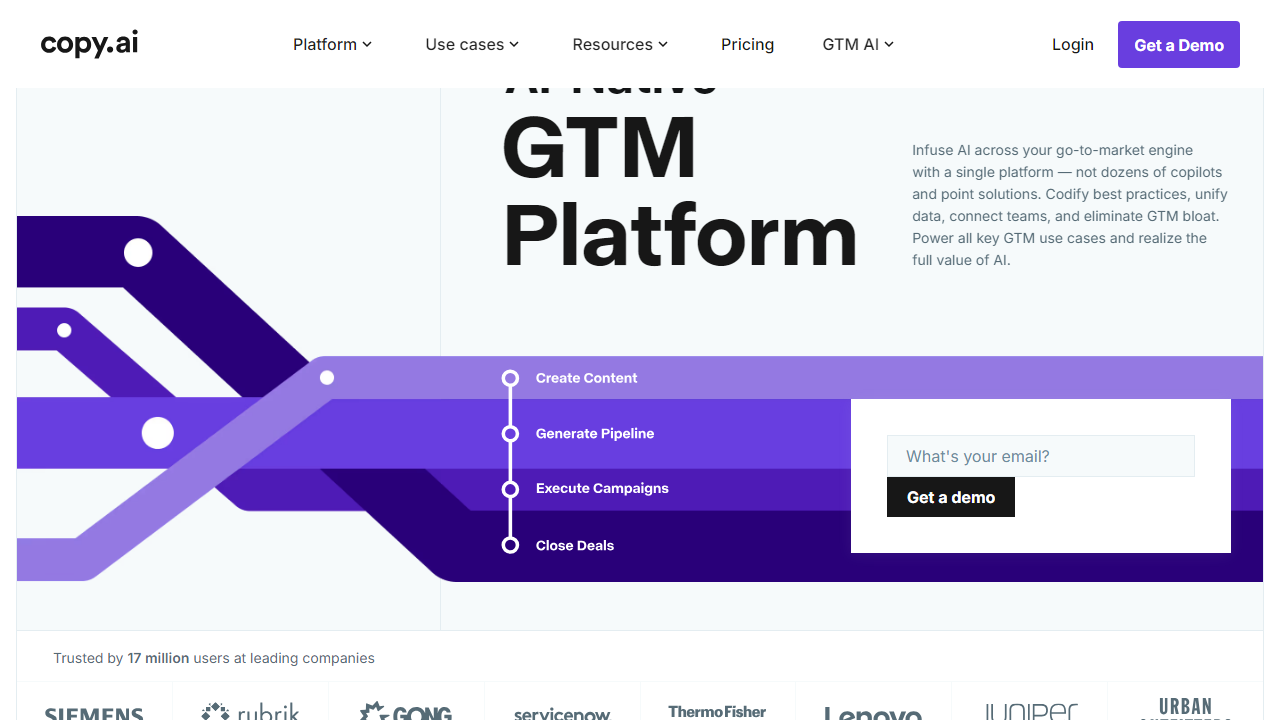
In 2026, Copy.ai has repositioned itself decisively as a GTM (Go-To-Market) AI platform rather than just a copywriting assistant. The shift is meaningful. Instead of generating isolated pieces of copy on demand, Copy.ai now emphasizes automated workflows that chain together multiple content tasks — think: pull a lead from your CRM, research their company, generate a personalized cold email sequence, and push it back to Salesforce, all with minimal human intervention. That’s a fundamentally different value proposition than “generate 10 subject line variations right now.”
The platform is backed by significant venture funding and has partnerships baked into its integrations layer with Salesforce, HubSpot, Zapier, and several marketing automation platforms. It competes most directly with Jasper at the enterprise level and with Writesonic and Rytr at the SMB level — though its current positioning leans harder toward the former.
Key Features of Copy.ai
Copy.ai’s feature set in 2026 is genuinely broad. Here’s what actually matters and how it performs in practice:
GTM Workflows
This is Copy.ai’s flagship differentiator and it’s legitimately impressive. Workflows allow you to build multi-step automated content pipelines using a no-code visual editor. You can chain inputs (like a company URL or CRM record), run them through research and generation steps, and export polished outputs — all without writing a single line of code. In our testing, a lead enrichment-to-cold-email workflow that would have taken a human 45 minutes per prospect ran in under 90 seconds per lead at scale.
Infobase (Brand Memory)
The Infobase feature lets you store your brand voice guidelines, product descriptions, target personas, competitive positioning, and FAQs in a persistent knowledge base that Copy.ai references automatically during generation. This solves one of the most frustrating problems with generic AI tools — having to re-explain your brand every single session. In practice, outputs using a well-populated Infobase were noticeably more on-brand and required about 40% less editing than cold-prompt outputs in our tests.
90+ Content Templates
Copy.ai still maintains its original template library, covering everything from Facebook ad copy and AIDA frameworks to product descriptions, webinar outlines, and YouTube scripts. The templates are well-structured and serve as solid starting points, though experienced marketers will find themselves outgrowing them quickly in favor of custom workflows.
Chat Interface (Chat.ai)
Copy.ai’s chat mode functions similarly to ChatGPT but with your Infobase data pre-loaded into context. It’s a genuinely useful addition for ad-hoc copy tasks — quick tagline brainstorms, email rewrites, CTA testing — without leaving the platform. Output quality here is solid but not materially better than a well-prompted Claude 3.5 or GPT-4o session.
Integrations and API Access
Native integrations include Salesforce, HubSpot, Zapier (which unlocks thousands of downstream connections), Webflow, and several SEO platforms. API access is available on Team and Enterprise plans, enabling developers to embed Copy.ai’s generation capabilities directly into their own tools and pipelines.
Pricing Plans
Copy.ai’s pricing has shifted upward since 2024, reflecting its repositioning toward business and enterprise buyers. Here’s the current 2026 breakdown — all prices reflect monthly billing; annual billing saves approximately 25%:
| Plan | Price/mo | Best For | Key Limit |
|---|---|---|---|
| Free | $0 | Casual users, evaluation | 2,000 words/mo, 1 seat |
| Pro | $49/mo | Freelancers, solopreneurs | Unlimited words, 1 seat, 5 Workflows |
| Team | $249/mo | Marketing teams (up to 5 seats) | Unlimited Workflows, API access, priority support |
| Enterprise | Custom | Large orgs, agencies | SSO, custom models, dedicated CSM |
The value inflection point is clearly at the Team plan. The Pro plan at $49/month is workable if you’re a solo marketer who lives in the tool daily, but the 5-Workflow cap is genuinely restrictive once you start building automation pipelines. The Team plan’s jump to $249/month is steep — that’s $2,988/year — and you’ll want to honestly assess whether the Workflow automation ROI justifies that spend versus using a combination of cheaper tools.
Who Should Use Copy.ai?
Best Copy.ai Alternatives
Copy.ai is strong, but it’s not the only game in town. Here’s how it stacks up against the four most viable alternatives in 2026:
| Tool | Starting Price | Best For | Our Rating |
|---|---|---|---|
| Jasper | $59/mo | Long-form content, brand consistency at scale | ⭐ 4.3/5 |
| Writesonic | $19/mo | Budget-conscious solo marketers and bloggers | ⭐ 3.9/5 |
| Rytr | $9/mo | Freelancers on a tight budget, quick drafts | ⭐ 3.5/5 |
| HubSpot AI Content | Included in HubSpot | Existing HubSpot users who want native AI | ⭐ 3.7/5 |
If long-form SEO content is your primary use case, Jasper remains the stronger pick despite costing $10 more per month at entry level. If budget is the main constraint, Writesonic at $19/month covers the core copywriting use cases at less than half the price of Copy.ai Pro. Copy.ai’s real edge over all of them is the GTM Workflow automation — if you don’t need that, you may be overpaying.
Frequently Asked Questions
Final Verdict: Is Copy.ai Worth It in 2026?
Here’s the honest answer: Copy.ai is worth it — but only for the right user. If you’re a marketing team of two or more running sales and content operations with any real volume, the GTM Workflow capabilities alone justify the Team plan investment. We’ve seen teams eliminate 8–10