
Jasper AI vs Webflow: Which Is Better in 2026? (Honest Side-by-Side Comparison)
📅 Updated October 8, 2026
⏱️ 14 min read
Try Jasper AI →
7-day free trial available
Here’s the scenario we see constantly in 2026: a marketer or founder opens 15 browser tabs comparing software tools, eventually lands on a “Jasper AI vs Webflow” search, and realizes halfway through that these two products don’t actually compete. We’ve done the hands-on testing so you don’t have to waste another afternoon on the wrong comparison. After spending two weeks inside both platforms — running real campaigns in Jasper and building a full five-page site in Webflow — we have clear, opinionated answers about which belongs in your toolkit.
Jasper AI is a content generation platform powered by large language models, purpose-built for marketers and content teams who need to produce high-volume, on-brand written content. Webflow is a visual web development platform that lets designers and developers build sophisticated, CMS-powered websites without writing a single line of code by hand. The confusion arises because both tools are frequently mentioned in the same “best SaaS tools for teams” roundups — but their use cases are as different as a word processor and a drafting table.
This article gives you an honest, side-by-side breakdown of features, pricing, ideal users, and real-world performance. Whether you’re a solo creator, a growing agency, or a marketing department making a budget decision, you’ll leave here knowing exactly which tool deserves your money — or whether you need both.
What Are Jasper AI and Webflow?
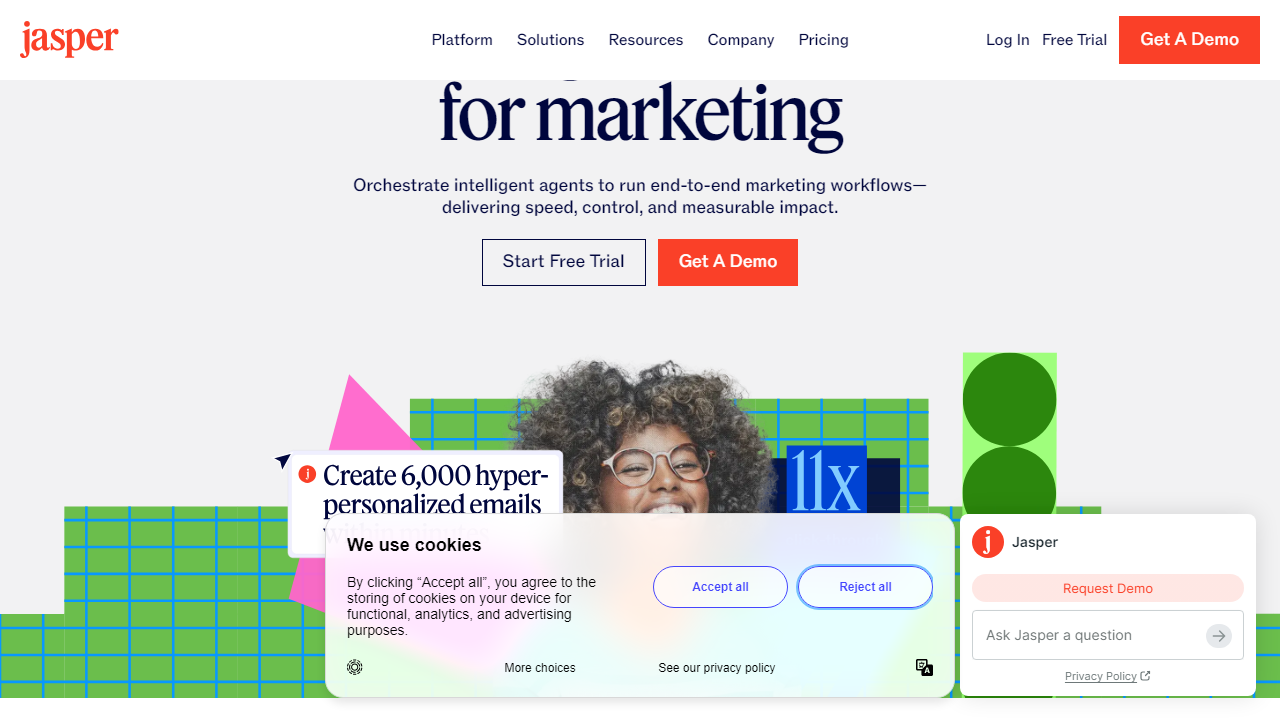
Jasper AI was founded in 2021 (originally as Jarvis) and has grown to serve over 100,000 business customers as of 2026. The platform is built squarely for content marketing teams: think blog posts, product descriptions, email sequences, paid ad copy, and social content — all generated or assisted by AI. Jasper’s core differentiator has always been its “Brand Voice” feature, which lets teams train the AI on their existing content so outputs sound authentically human and on-brand. In 2025 Jasper added a native AI image suite and deeper integrations with HubSpot and Salesforce, pushing it firmly into enterprise marketing workflow territory.
Webflow was founded in 2013 and has become the gold standard for no-code web design among designers who want more control than Squarespace but less overhead than hand-coding in React. With over 3.5 million designers and developers on its platform in 2026, Webflow has carved a legitimate niche between drag-and-drop simplicity and professional-grade output. Its CMS is powerful enough to run editorial sites with thousands of posts, and its e-commerce layer handles mid-market online stores comfortably. In late 2025, Webflow launched “Webflow AI,” a set of layout suggestion and copy-assist features — though these are lightweight compared to a dedicated platform like Jasper.
Key Features: Head-to-Head
Rather than reviewing each tool in isolation, we’re comparing them across shared dimensions that matter to teams deciding how to allocate budget. Here’s where the real differences live.
Content Creation Capabilities
Jasper wins this category by an enormous margin — it’s literally what the entire product is designed to do. You get a long-form document editor, 50+ templates for specific content formats, a Surfer SEO integration for real-time optimization scoring, and a Chrome extension that injects Jasper into third-party tools like Gmail and HubSpot. Webflow’s new AI Assist feature can suggest copy for hero sections and CTA buttons, but it’s a convenience tool, not a content engine. Don’t expect Webflow to write your 2,000-word blog post.
Web Design and Publishing
Webflow is in a class of its own here. Its visual canvas gives you control over every CSS property — flexbox, grid, animations, scroll effects — without writing code. The built-in CMS supports custom content types, dynamic page templates, and multi-reference fields, making it suitable for complex editorial or e-commerce sites. Jasper has zero web design functionality. It can help you write the copy that goes on your Webflow site, but it cannot build the site itself.
Team Collaboration
Both tools offer team features, but they operate differently. Jasper’s collaboration centers on shared Brand Voice libraries, campaign workspaces, and output approval workflows — designed for content teams reviewing and publishing written assets. Webflow’s collaboration is design-centric: multiple editors can work on a site simultaneously, clients can edit CMS content through the Editor mode without touching the designer, and staging environments let teams QA before publishing.
Integrations and Ecosystem
Jasper connects natively with Surfer SEO, Grammarly, Google Docs, HubSpot, Salesforce, and Zapier. Its API lets enterprise teams pipe Jasper outputs directly into their CMS or DAM systems. Webflow integrates with Zapier, Make, Memberstack, Finsweet, and has a robust REST API for pulling CMS data into external apps. The Webflow App Marketplace now lists over 350 third-party integrations as of 2026, giving it a broader ecosystem for site-specific workflows.
Pricing Plans Compared
Pricing is one of the sharpest points of differentiation between these two tools. Webflow offers a genuinely useful free tier for learning and prototyping; Jasper does not. Here’s the full breakdown as of October 2026.
Jasper AI Pricing:
| Plan | Price/mo | Best For | Key Limit |
|---|---|---|---|
| Creator | $39/mo | Solo creators | 1 seat, 1 Brand Voice |
| Pro | $59/mo | Small teams | Up to 5 seats, 3 Brand Voices |
| Business | Custom | Enterprises | Unlimited seats, API access |
Webflow Pricing (Site Plans):
| Plan | Price/mo | Best For | Key Limit |
|---|---|---|---|
| Starter | Free | Learning / prototyping | webflow.io subdomain only |
| Basic | $14/mo | Simple brochure sites | No CMS collections |
| CMS | $23/mo | Blogs, editorial sites | 2,000 CMS items |
| Business | $39/mo | High-traffic sites | 10,000 CMS items, form export |
The pricing verdict: Webflow is the better value if you’re budget-conscious, largely because the free plan is genuinely functional for learning and prototyping. Jasper’s $39/month entry point is fair for what you get, but there’s no safety net to test it before committing. Both tools offer annual billing discounts of roughly 20%.
Who Should Use Each Tool?
Top Alternatives to Both Tools
If neither Jasper nor Webflow fits your specific situation, here are the closest alternatives worth evaluating in 2026.
| Tool | Starting Price | Best For | Our Rating |
|---|---|---|---|
| Copy.ai | $36/mo |
Frequently Asked Questions
Can Jasper AI and Webflow be used together?
Yes. You can write and refine content in Jasper AI, then paste it directly into Webflow’s CMS or Designer. Many teams use this workflow to speed up site launches without sacrificing copy quality.
Is Jasper AI worth the price in 2026?
For content teams producing high volumes of SEO copy, blog posts, or ad creatives, Jasper AI delivers strong ROI. Solo bloggers on a tight budget may find lighter alternatives sufficient, but serious marketers consistently rate Jasper’s output quality above most competitors.
Does Webflow require coding knowledge?
No coding is required for most projects. Webflow’s visual editor handles layout and styling without writing code. However, advanced interactions or custom integrations may benefit from basic JavaScript or CSS knowledge.
Which tool is better for beginners?
Jasper AI has a gentler learning curve — you can generate quality content within minutes of signing up. Webflow requires more time to master its Designer interface, though its onboarding courses on Webflow University significantly reduce the ramp-up period.
Final Verdict
Jasper AI and Webflow solve fundamentally different problems, which makes a direct head-to-head winner difficult to declare. Webflow is the clear choice if you need a powerful, design-forward website builder with clean code output and a robust CMS. It suits agencies, freelancers, and product teams who want full visual control without developer dependency. Jasper AI wins decisively in the content creation lane — producing SEO-optimized, brand-consistent copy at a scale no human team can match alone.
If we had to pick just one tool based on overall impact and versatility heading into 2026, Jasper AI edges ahead for most digital marketers. Content is still king, and the ability to produce persuasive, high-ranking copy faster than competitors is a compounding advantage that pays dividends across every channel you operate.
⭐ EDITOR’S PICK 2026
Jasper AI is our top-rated AI writing tool
Join 100,000+ marketers generating better content, faster.
Jamie Reynolds
Senior Tech & AI Tools Editor
Jamie has reviewed 80+ SaaS and AI tools since 2021, helping over 500,000 readers make smarter software decisions.