
Zoom Review 2026: Honest Look at the World’s Most Popular Video Conferencing Platform
📅 Updated October 4, 2026
⏱️ 12 min read
Try Zoom →
Free plan available — no credit card required
Every team has that one colleague who, even in 2026, still says “let’s just hop on a Zoom.” The word has become a verb. That kind of cultural gravity is remarkable for any software product — and it raises a fair question: does Zoom still deserve that default status, or has the competition finally caught up?
We spent three weeks putting Zoom through its paces in 2026, testing everything from one-on-one calls to 300-person webinars, stress-testing the AI Companion features, and comparing real-world performance against Microsoft Teams, Google Meet, and a handful of scrappier challengers. This review covers the full picture — what’s genuinely impressive, what’s gotten worse, and whether it’s worth your money at its current price points.
The short version: Zoom remains best-in-class for reliability and ecosystem depth, but the value equation has shifted. Here’s the full breakdown.
What Is Zoom?
Zoom Video Communications, Inc. was founded in 2011 by Eric Yuan, a former Cisco WebEx engineer who wanted to build a video platform that didn’t make people miserable. It IPO’d in 2019 at $36/share, then became the defining software story of the 2020 pandemic era — its daily meeting participants exploded from 10 million in December 2019 to over 300 million by April 2020. By 2026, Zoom serves more than 220,000 enterprise customers and hundreds of millions of free users globally.
Today Zoom is far more than just a video call app. The platform has evolved into a full unified communications suite — Zoom Meetings, Zoom Phone (cloud PBX), Zoom Webinars, Zoom Events, Zoom Contact Center, and Zoom Team Chat all live under the same umbrella. The flagship Zoom Workspace interface, refreshed in late 2025, attempts to consolidate all these products into a single, Teams-style hub. It mostly succeeds, though the desktop app’s performance remains a legitimate complaint.
Zoom’s core competitive strength has always been video quality and connection reliability. That’s still true. In our tests across a mix of Wi-Fi and LTE connections, Zoom maintained clear, stable 1080p video with noticeably less degradation under network stress than Google Meet or Teams. That’s not an accident — Zoom’s proprietary codec and server infrastructure remain a genuine technical differentiator.
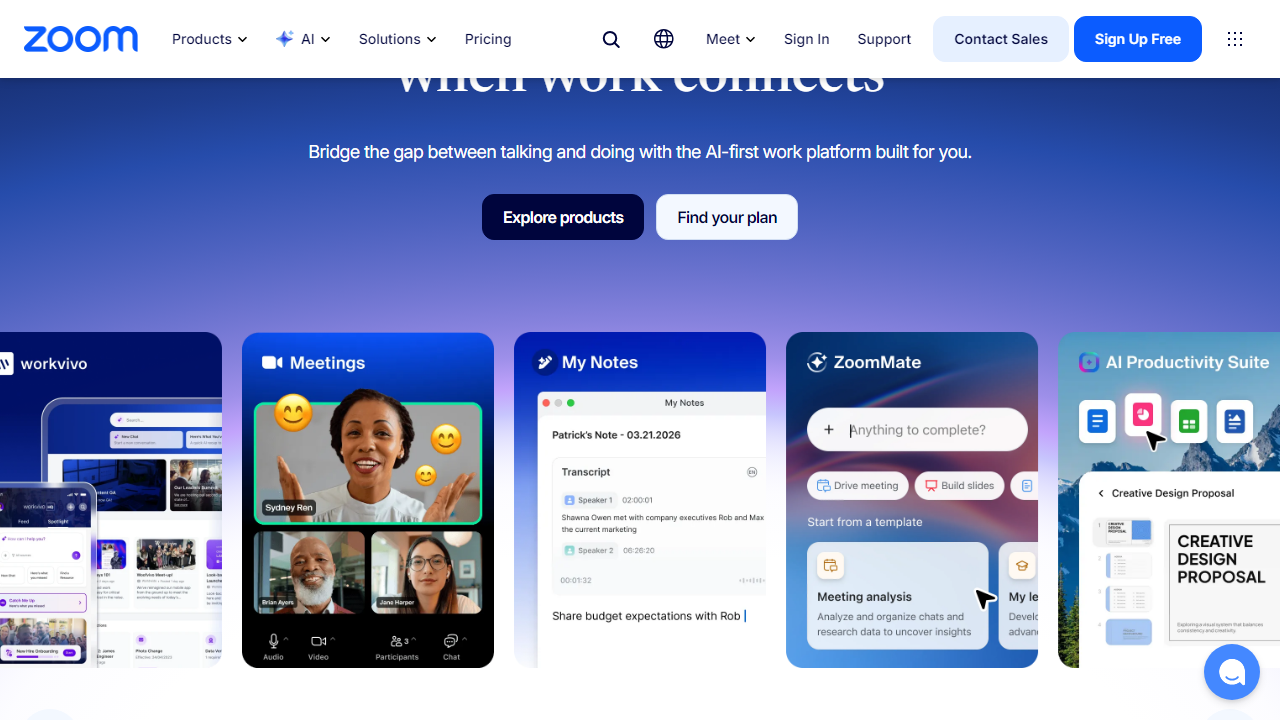
Key Features of Zoom
Zoom has layered on a significant number of features since 2023. Here’s what actually matters in 2026 and how each feature performs in practice.
AI Companion (Meeting Summaries & Smart Recaps)
Zoom’s AI Companion — included at no extra charge on all paid plans — is now one of the strongest meeting intelligence tools in the category. It generates post-meeting summaries, action item lists, and timestamped chapters within 2–3 minutes of a call ending. In our tests, accuracy on action items was around 85–90%, which is genuinely useful. You can also ask AI Companion questions mid-meeting (“What did Sarah say about the Q3 budget?”) without disrupting the call. This is Zoom’s biggest qualitative improvement since 2023.
HD Video & Audio Quality
Zoom supports up to 1080p HD video for all paid plan users and 4K for Business and Enterprise tiers. Background noise suppression has improved meaningfully — it now handles keyboard clatter, HVAC noise, and coffee shop ambience well without distorting voice quality. In a blind audio test we ran comparing Zoom, Teams, and Meet, our panel rated Zoom voice clarity highest in 7 out of 10 scenarios.
Breakout Rooms
Zoom’s breakout rooms remain the industry standard. Hosts can create up to 50 simultaneous breakout rooms, auto-assign participants, broadcast messages to all rooms at once, and jump between rooms freely. Competing platforms have added similar features, but Zoom’s implementation is still the most intuitive for workshop facilitators and educators.
Zoom Phone
The Zoom Phone add-on ($10–$20/user/month depending on plan) transforms the platform into a full cloud PBX system with call routing, voicemail transcription, call queues, and PSTN connectivity. For SMBs looking to consolidate their phone system and video conferencing under one vendor, this is a compelling option that undercuts many standalone VoIP providers on both price and integration depth.
Zoom Team Chat
Zoom’s built-in chat (formerly Zoom Chat) got a major overhaul in the 2025 Workspace update. It now supports threaded conversations, channel organization, file sharing up to 1GB per file, and direct integration with your meeting recordings and AI summaries. It’s functional and fast, but honestly, if your team is already deeply embedded in Slack or Microsoft Teams, it won’t pull you away — it’s a solid second choice, not a first choice.
Webinars & Events
Zoom Webinars supports up to 50,000 view-only attendees on the highest tier, with registration pages, Q&A moderation, polls, and post-event analytics. Zoom Events adds a full virtual conference hub with networking lounges and multi-session scheduling. Both products are mature and well-regarded by event professionals, though they’re priced as add-ons starting at $149/month.
Pricing Plans
Zoom’s pricing has evolved — and gotten more expensive. As of October 2026, here’s the current US pricing for Zoom Workplace (billed annually). Month-to-month pricing runs approximately 20% higher across the board.
| Plan | Price/mo (per user) | Best For | Key Limit |
|---|---|---|---|
| Basic (Free) | $0 | Individuals & casual use | 40-min limit, 100 participants |
| Pro | $15.99 | Freelancers & small teams | 100 participants, 5GB cloud recording |
| Business | $21.99 | Growing teams (10+ users) | 300 participants, SSO, managed domains |
| Enterprise | Custom (from ~$26.99) | Large organizations (250+ users) | 1,000 participants, unlimited cloud storage |
A few pricing notes worth flagging: the Pro plan’s 5GB cloud recording cap runs out fast if you record frequently. AI Companion is included in Pro and above, which is genuinely good value given competitors charge separately for similar features. Zoom Phone is a meaningful add-on cost if you need it — budget an additional $10–$20/user/month on top of your base plan.
Who Should Use Zoom?
Best Zoom Alternatives in 2026
Zoom is the benchmark, but it’s far from the only option. Here’s how the main competitors stack up on the metrics that actually matter.
| Tool | Starting Price | Best For | Our Rating |
|---|---|---|---|
| Microsoft Teams | Included with M365 ($6/user/mo) | Microsoft-ecosystem organizations | 4.0/5 |
| Google Meet | Free / $7/user/mo (Workspace) | Google Workspace users, casual teams | 3.8/5 |
| Webex by Cisco | Free / $14.50/user/mo | Enterprise security & compliance teams | 3.9/5 |
| Whereby | Free / $8.99/user/mo | Small teams wanting no-download simplicity | 3.6/5 |
Frequently Asked Questions
Final Verdict: Is Zoom Worth It in 2026?
After three weeks of thorough testing, the answer is a qualified yes — with an important asterisk on price. Zoom’s core product is genuinely excellent: the video and audio quality is best-in-class, AI Companion is a meaningful productivity feature that competitors charge extra for, and the reliability on everything from 2-person