
Semrush Review 2026: Honest Look at the #1 SEO Platform (Is It Still Worth It?)
📅 Updated May 24, 2026
⏱️ 14 min read
Try SEMrush →
7-day free trial available
You’ve heard the pitch a hundred times: “Semrush does everything.” And after spending the better part of the last year actively using the platform across client campaigns, personal projects, and head-to-head competitor tests, I can tell you that — annoyingly — it’s mostly true. Whether you’re trying to outrank a competitor, uncover paid search gaps, audit a technically broken website, or just figure out why your traffic dropped 30% last quarter, Semrush has a tool for it. The real question in 2026 isn’t whether Semrush is good. It’s whether it’s good enough for your specific situation at its current price point.
This review covers everything you need to make that call: what the platform does well, where it falls short, how the 2026 pricing compares to the competition, and who should actually be paying for it. We tested every major feature suite — keyword research, site auditing, backlink analysis, competitive intelligence, content tools, and the newer AI-assisted workflows that Semrush rolled out through 2025 and into 2026. No fluff, no vendor talking points.
If you’ve been on the fence about Semrush for a while, or you’re re-evaluating your current subscription, this is the most comprehensive and honest breakdown you’ll find. Let’s get into it.
What Is Semrush?
Semrush is a cloud-based digital marketing platform founded in 2008 by Oleg Shchegolev and Dmitry Melnikov in St. Petersburg, Russia — later relocating its headquarters to Boston, Massachusetts. What started as a modest keyword research tool for SEO professionals has evolved into one of the most expansive marketing intelligence platforms on the planet. As of 2026, Semrush serves over 10 million users globally, including marketing teams at Samsung, Tesla, IBM, and thousands of digital agencies of every size.
The platform spans more than 55 individual tools organized into toolkit categories: SEO, Advertising, Content Marketing, Social Media, Competitive Research, and a growing suite of Agency Solutions. Its core competitive advantage is data — Semrush’s database houses over 26 billion keywords, tracks more than 43 trillion backlinks, and monitors over 800 million domains. Those aren’t just impressive numbers on a marketing page; in practice, they mean you’re getting some of the most accurate organic traffic estimates, backlink profiles, and keyword difficulty scores available anywhere.
In 2025 and into 2026, Semrush made notable investments in AI-assisted features — including AI-powered content briefs, an integrated writing assistant, and AI-generated keyword clustering — positioning the platform to stay relevant in a search landscape increasingly dominated by generative and conversational search behavior. Whether those AI tools fully deliver is something we’ll cover in the features section below.
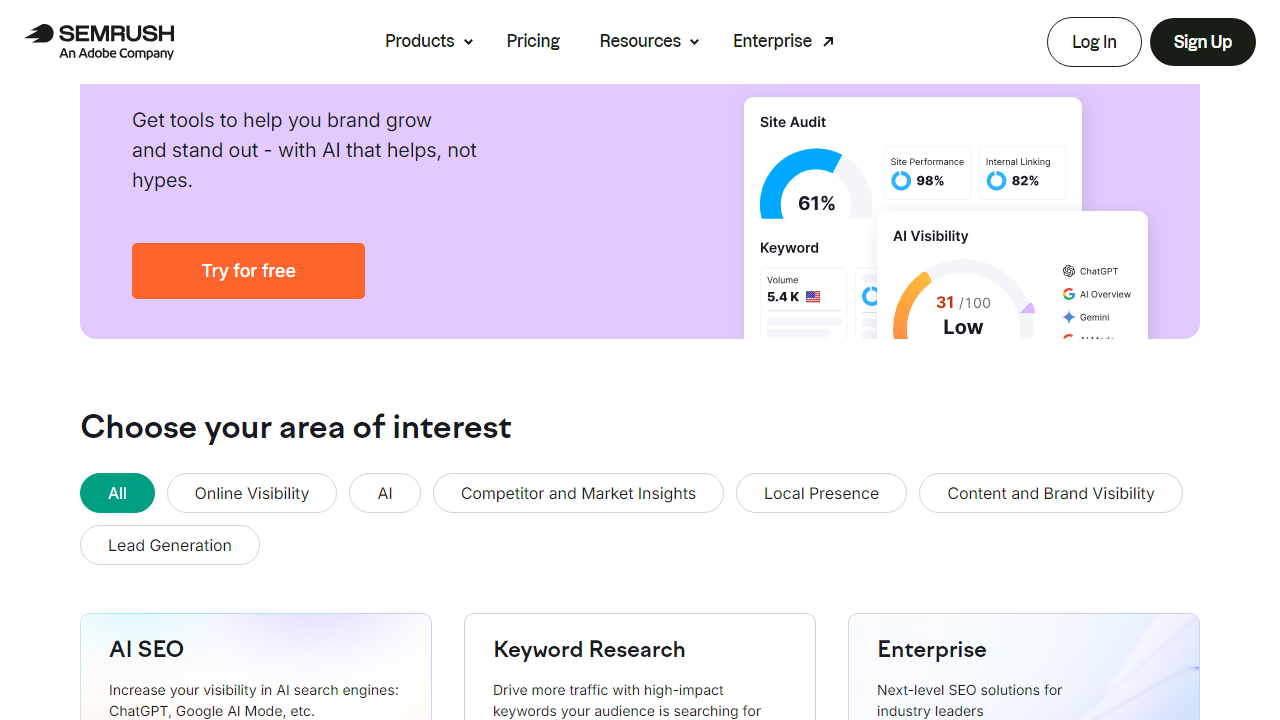
Key Features of Semrush
Semrush’s feature set is genuinely enormous, and listing every tool would take a small book. Instead, here’s an honest deep-dive into the features that matter most and that you’ll actually use on a regular basis.
Keyword Research
This is still Semrush’s crown jewel, and it remains best-in-class in 2026. The Keyword Magic Tool gives you access to over 26 billion keyword suggestions with filters for search volume, keyword difficulty, intent (informational, commercial, transactional, navigational), SERP features, and CPC data. You can cluster keywords by topic, export lists with a single click, and get granular data broken down by country or region. The Keyword Difficulty (KD) score, while not perfect, is among the most reliable in the industry — it’s actually calibrated against real ranking data rather than just backlink counts, which makes it meaningfully more accurate than some competitors.
Competitor Research & Traffic Analytics
Semrush’s Domain Overview and Traffic Analytics tools are where the platform truly separates itself from lighter alternatives. You can plug in any competitor’s domain and get estimated monthly visits, top organic keywords, paid keywords, display advertising data, traffic sources, and even audience demographics. The organic research tool shows you exactly which keywords a competitor ranks for, their position history, and the pages driving the most traffic. In our testing, Semrush’s traffic estimates came closest to actual Google Search Console data compared to Ahrefs and Moz — not always perfect, but consistently the most directionally accurate.
Site Audit
The Site Audit tool crawls up to 100,000 pages per crawl (on the Pro plan, up to 20,000) and checks for 140+ technical SEO issues — everything from broken links, missing meta descriptions, and duplicate content, to Core Web Vitals problems, HTTPS issues, and internal linking gaps. The issue prioritization is genuinely useful: it separates errors (critical), warnings (moderate), and notices (minor), and each issue comes with a plain-English explanation and a “How to fix it” guide. For technical SEO work, this tool alone is worth a significant chunk of the subscription cost.
Backlink Analysis
Semrush’s backlink database covers 43+ trillion backlinks and updates daily. The Backlink Analytics tool lets you analyze any domain’s link profile — referring domains, anchor text distribution, link authority scores, follow vs. nofollow ratios, and new/lost links over time. The Backlink Gap tool is particularly useful for identifying link opportunities your competitors have that you don’t. It’s not quite as deep as Ahrefs on backlink data alone, but for most practical link building and audit use cases, it’s more than sufficient.
Position Tracking
Semrush’s Position Tracking tool monitors daily keyword rankings for your target domain across desktop and mobile, broken down by device, location (down to zip code level in the US), and SERP feature visibility. You can track up to 500 keywords on the Pro plan and get automated weekly email reports. The Sensor feature, which monitors Google algorithm volatility in real time, is a genuinely useful add-on that helps you contextualize unexplained ranking fluctuations.
Content Marketing Toolkit
The Content Marketing toolkit includes the SEO Content Template (which analyzes top-ranking pages and generates content recommendations), the SEO Writing Assistant (a real-time editor that scores your content on readability, SEO, originality, and tone), and the Topic Research tool. In 2025–2026, Semrush significantly improved its AI-assisted content brief generation, and the results are now genuinely usable rather than generic. The ContentShake AI tool, which can draft full articles with SEO optimization baked in, is available as an add-on and has improved considerably — though experienced writers will still want to treat it as a starting point rather than a finished product.
Advertising Research
For paid search professionals, Semrush’s Advertising Research tool is a legitimate competitive advantage. You can see competitors’ active Google Ads, their historical ad copy, which keywords they’re bidding on, and estimated ad spend. The PLA (Product Listing Ad) research is particularly strong for e-commerce teams. This level of paid intelligence is something you simply can’t get from free tools, and it’s one reason many PPC agencies keep Semrush subscriptions even if they use other platforms for organic SEO work.
Pricing Plans
Semrush pricing has crept upward over the past few years, and in 2026 it remains one of the more expensive tools in the SEO category. That said, given the breadth of what’s included, the cost-per-feature math is often better than it looks at first glance. Here’s the current breakdown (monthly billing; annual billing saves approximately 17%):
| Plan | Price/mo | Best For | Key Limit |
|---|---|---|---|
| Pro | $139.95 | Freelancers & small in-house teams | 5 projects, 500 keywords tracked, 1 user |
| Guru | $249.95 | Growing agencies & mid-size businesses | 15 projects, 1,500 keywords tracked, 1 user |
| Business | $499.95 | Large agencies & enterprise marketing teams | 40 projects, 5,000 keywords tracked, 3 users |
| Enterprise | Custom pricing | Large-scale enterprise & multi-brand organizations | Custom limits, API access, dedicated support |
A few important notes on pricing: Additional user seats cost $45/mo per seat across all plans, which adds up quickly for teams. Several advanced tools — including Semrush .Trends, ContentShake AI, and the Agency Growth Kit — are available as paid add-ons ranging from $29/mo to $200/mo. The 7-day free trial gives you Pro-level access with no credit card required, which is genuinely useful for evaluation. Annual billing brings the Pro plan to approximately $117.33/mo and Guru to $208.33/mo — meaningful savings if you’re committed long-term.
Who Should Use Semrush?
Semrush isn’t the right fit for everyone. Here’s how it stacks up against the top competitors in 2026:
| Tool | Starting Price | Best For | Rating |
|---|---|---|---|
| Ahrefs | $129/mo | Backlink analysis & link building | ⭐ 4.7/5 |
| Moz Pro | $99/mo | Beginners & small businesses | ⭐ 4.3/5 |
| Mangools | $29/mo | Budget-conscious bloggers & freelancers | ⭐ 4.4/5 |
| SE Ranking | $65/mo | Agencies managing multiple clients | ⭐ 4.5/5 |
Frequently Asked Questions
Is Semrush free to use?
Semrush offers a limited free plan that allows up to 10 requests per day across core reports. It’s useful for a quick taste of the platform, but serious SEO work requires a paid subscription starting at $139.95/month in 2026.
How does Semrush compare to Ahrefs in 2026?
Semrush edges out Ahrefs when it comes to keyword research volume, PPC data, and content marketing tools. Ahrefs remains the preferred choice for in-depth backlink analysis. If your focus is multi-channel digital marketing, Semrush offers more overall value.
Does Semrush offer a money-back guarantee?
Yes. Semrush provides a 7-day money-back guarantee on new subscriptions. Additionally, they frequently offer extended free trials — sometimes up to 14 days — through promotional partner links, giving you more time to evaluate the platform risk-free.
Is Semrush suitable for beginners?
Absolutely. While Semrush packs a huge feature set, its onboarding workflow and guided projects make it accessible for beginners. The learning curve exists, but Semrush Academy — offering free certified courses — helps new users get up to speed quickly.
Final Verdict: Is Semrush Worth It in 2026?
After testing Semrush extensively across keyword research, site auditing, backlink tracking, and content optimization, our conclusion is clear: it remains the most comprehensive all-in-one SEO and digital marketing platform available in 2026. The breadth of tools packed under a single subscription is unmatched, and the platform’s continued investment in AI-assisted features has only widened the gap between it and most competitors.
That said, Semrush isn’t for everyone. If you’re a casual blogger on a tight budget, Mangools or a free tool may serve your needs. But for marketing teams, agencies, and growth-focused businesses that rely on data-driven decisions, Semrush consistently delivers a measurable return on investment. The price increase over the years is noticeable, yet the value-to-feature ratio still holds up well when stacked against the alternatives.
⭐ Editor’s Pick 2026
Semrush — Our #1 Recommended SEO Platform
Join 10 million+ marketers. Start your free trial — no credit card required.
GetClarityHub Editorial Team
The GetClarityHub Editorial Team rigorously tests and reviews digital marketing tools so you don’t have to. Our assessments are independent, hands-on, and updated regularly to reflect the latest platform changes.